

If you sell across more than one sales channel — a marketplace like Amazon or eBay, a storefront like Shopify or your own website, plus a payment processor like Stripe or PayPal — every channel deposits money into your bank differently, taxes sales differently, and reports its fees differently. This guide shows how to keep all of that clean in your accounting software using Synder’s Summary Sync. Wherever we show an example, we use QuickBooks Online, but the same approach works with Xero and other supported accounting platforms — the concepts are identical, only the field names differ.
There is a companion guide for Per-Transaction Sync. If you would rather post one entry per order, read that one. This guide is Summary-only so that every topic can be explained the way it actually works in Summary Sync, with a link to the specific deep-dive guide for each step.
- Who this guide is for
- First, what a clearing account is
- How Synder handles multi-channel sales data in Summary Sync
- The five topics that matter for multi-channel selling
- Putting it together: a multi-channel Summary Sync checklist
- Related guides
Who this guide is for
- You sell on two or more channels (any mix of marketplaces, ecommerce stores, and payment processors).
- You want clean books that reconcile to every payout, with revenue, fees, taxes, and refunds each landing where they belong.
- You are using — or plan to use — Synder’s Summary Sync, which posts one grouped entry per period or payout rather than one entry per order.
First, what a clearing account is
A clearing account (also called a funds-in-transit account) is a temporary holding account that sits between your sales and your bank. When a customer pays, the money does not land in your checking account instantly — the channel holds it, subtracts its fees, and pays you out later as a lump-sum payout. The clearing account is where Synder parks that money in the meantime.
Think of it as a waiting room for your money:
- When sales post, Synder records revenue, taxes, and fees, and the net amount owed to you goes into the clearing account.
- When the channel actually deposits the payout into your bank, Synder moves that same amount out of the clearing account.
- When everything is set up correctly, the clearing account should return to zero after each payout is fully reconciled. A balance that never clears is your signal that something is off.
For a full walkthrough, see Payouts, Clearing Accounts, and Reconciliation — Comprehensive Guide.
How Synder handles multi-channel sales data in Summary Sync
This is a sales-channel topic, not a marketplace-only one. Whether the money comes from a marketplace, a hosted store, or a standalone payment processor, Synder treats each connected channel as its own data source with its own clearing account, its own mapping, and its own payout cycle.
How Summary Sync aggregates your channels
In Summary Sync, Synder does not post every order. It collects all the activity in a period — sales, refunds, fees, taxes, adjustments — and posts one grouped summary that breaks the total into its parts so each line hits the right account. When you connect all the platforms in your money flow, Synder links them intelligently:
- Summaries are built by period, not per order. A summary covers everything that happened in its window — daily, weekly, per payout, or a custom range. An order and its payment can land in different summaries if they occur in different periods; Synder does not hold a payment back to sit with its order.
- Gateway activity is separated by a mapping line, not a separate summary. Within a summary, money that came through a store gateway (e.g. PayPal paying Shopify orders) is broken out onto its own ecommerce line on the mapping, so store-paid revenue stays distinguishable from a processor’s own standalone sales — all inside the same grouped entry.
For this to work, connect every platform in your money flow and use the same import start date across the store and its gateways — otherwise orders paid through a gateway connected later will be missed. The full behavior is in Summary Sync for Ecommerce: Things You Need to Know and How Is Data Collected for Summaries in Synder.
The ecommerce flow: how your store and its gateway line up
When a payment processor also acts as a gateway for your store (for example, PayPal or Stripe paying off Shopify orders), Synder connects the two sides for you in Summary Sync. Here is what to expect, using Shopify + PayPal:
- An extra “ecommerce” mapping line appears on your payment processor. On the PayPal mapping you will see a line labeled ecommerce. This line represents the money coming in from PayPal that paid off your Shopify orders — it keeps store-paid revenue distinct from PayPal’s own standalone sales.
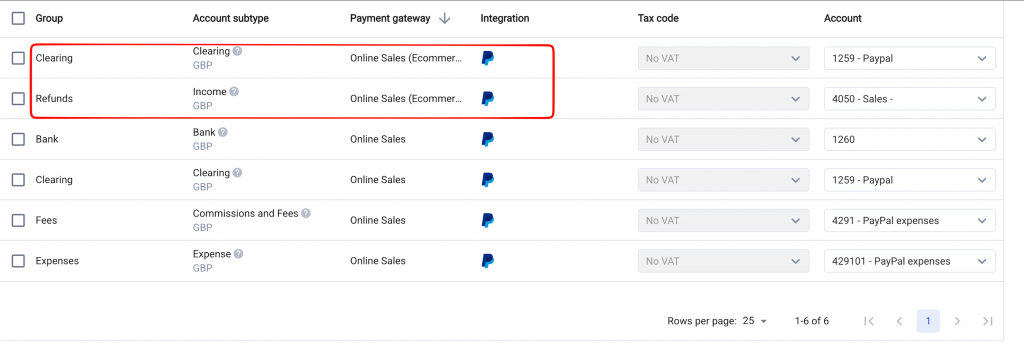
- The transaction still comes in as a PayPal transaction, enriched by Shopify. The underlying charge is recorded through PayPal’s configuration, and Synder enriches it with the matching Shopify order data — correct line items, products, discounts, and shipping — so the summary reflects what was actually sold, not just a lump payment.
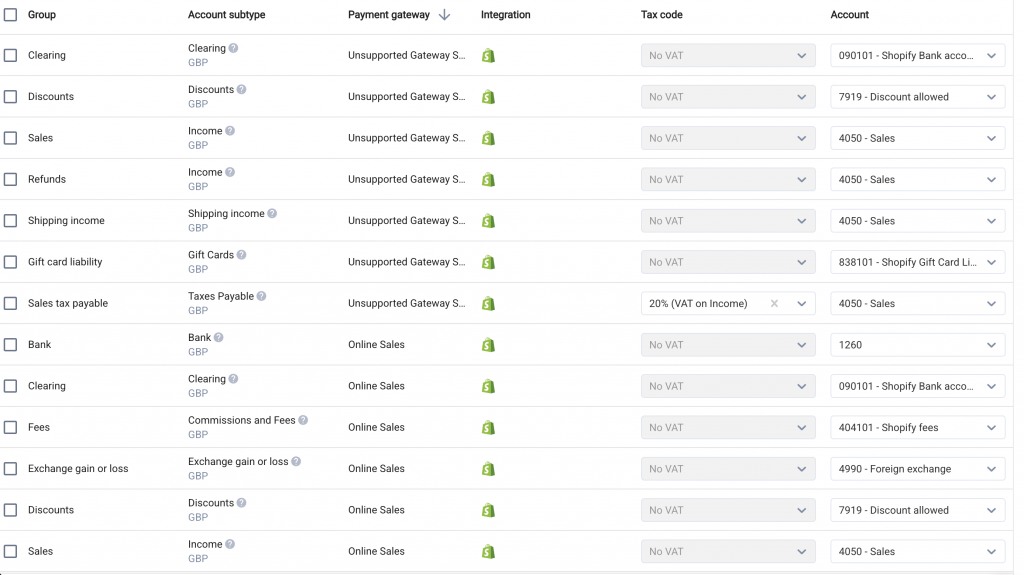
- Unsupported gateways fall back to the store mapping. If Shopify uses a gateway that Synder does not support, that revenue does not disappear — it comes in under “unsupported gateway sales” on the Shopify mapping, so it is still captured and reconciled on the store side.
On the Shopify mapping, revenue from a gateway Synder doesn’t support falls back to dedicated Unsupported Gateway Sales lines, so it’s still captured and reconciled on the store side.
What a gateway that pays your store looks like on the summary
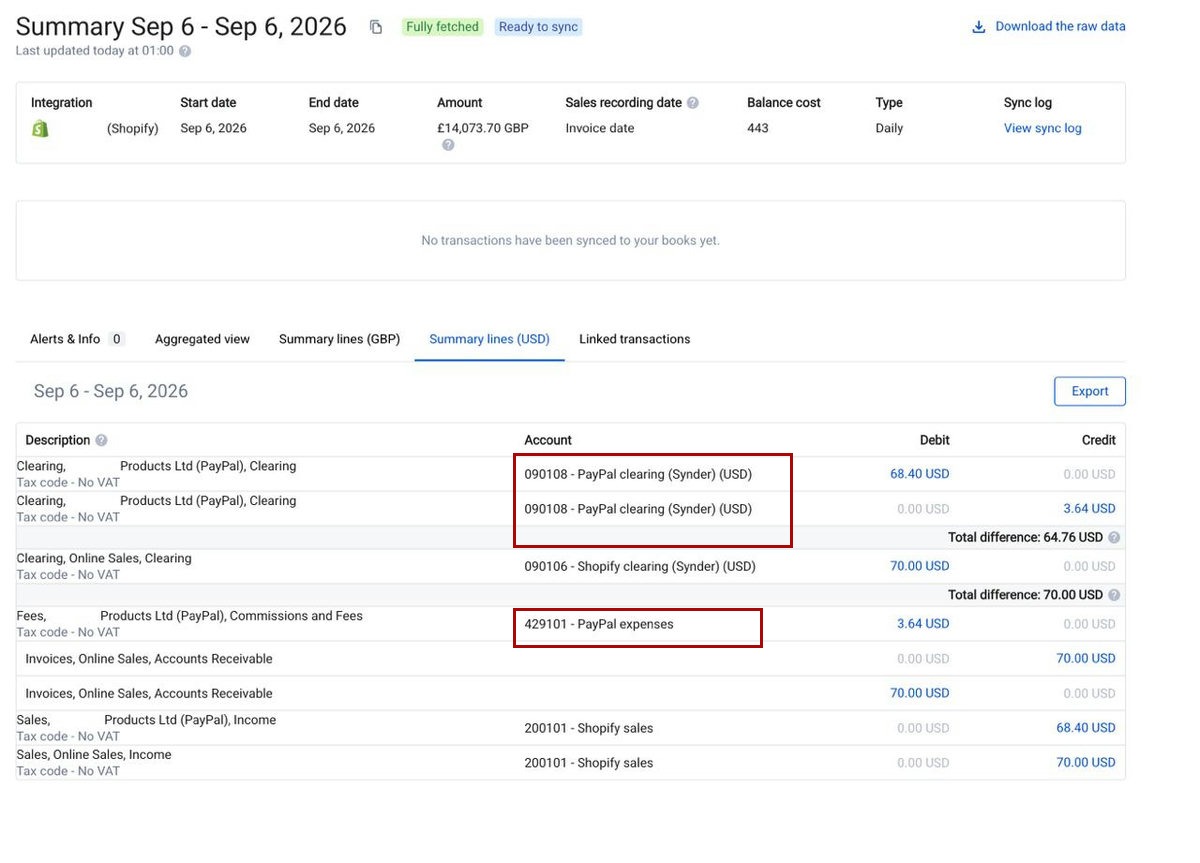
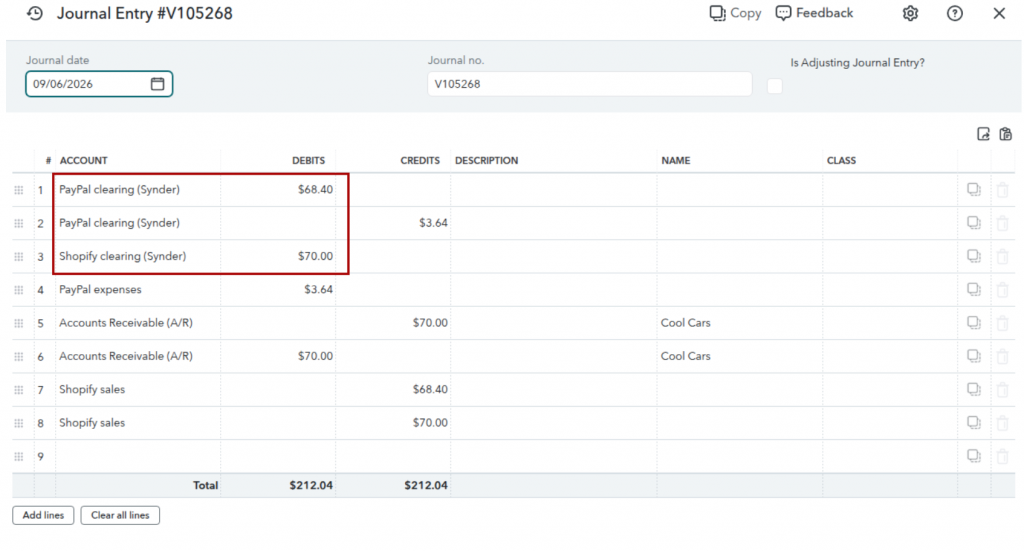
When a gateway such as PayPal pays off your Shopify orders, that gateway’s activity does not get its own separate summary — it appears right on the Shopify summary, broken out onto its own dedicated lines. In a single Shopify daily summary you will see both sides side by side:
- Shopify’s own lines — the store clearing account and Shopify sales for orders Shopify itself settled.
- The gateway’s lines, nested in the same summary — a PayPal clearing line for the money PayPal is holding on your behalf, a PayPal expenses line for its processing fees, and the matching sales — all separated by a line within the summary, not split into a second summary.
This is exactly why each gateway gets its own mapping line under the store (covered next): so PayPal’s clearing and fees post to PayPal accounts while Shopify’s own settlements post to Shopify accounts, even though they share one summary.
Each integration has its own mapping
Mapping is where you tell Synder which account each part of a summary should post to. Every connected integration has its own mapping lines — its clearing account, bank/deposit account, income account, taxes payable, fees, and (where relevant) accounts receivable. That is what lets each channel behave differently. On the Mappings list you will see:
- An ecommerce integration tab (e.g. Shopify) that shows the store plus a separate mapping line per gateway — so you can map Shopify+PayPal differently from Shopify+PayPal, and control where each gateway’s fees and payments land.
- A standalone gateway tab (e.g. PayPal), which appears only when that processor also handles non-ecommerce sales.
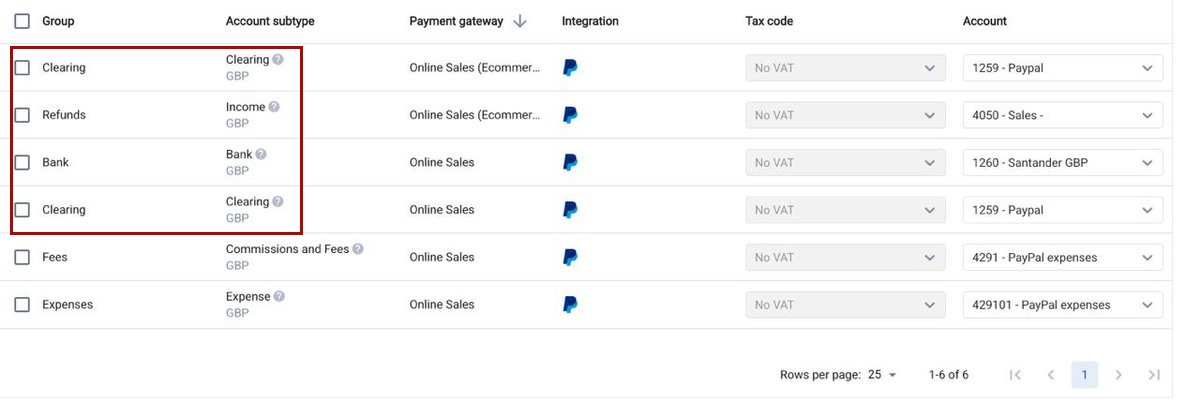
If a new gateway starts processing your orders, Synder adds its mapping lines automatically. Before your first sync, run the Settings Checklist: Configure Synder Before Your First Sync.
The five topics that matter for multi-channel selling
Each of the five topics below can behave differently for each sales channel. For each one, we explain briefly how it is done in Summary Sync and link the specific guide that walks you through it.
1. Give each sales channel its own clearing account
How it is done: Connect each sales channel as its own integration and, in that integration’s mapping, assign it a separate clearing account — for example “Amazon Clearing,” “Shopify Payments Clearing,” “PayPal Clearing.” Synder posts each channel’s summaries into its own clearing account and matches each payout against that same account. If channels share one clearing account you can never tell whose payout is whose, and the balance never resolves.
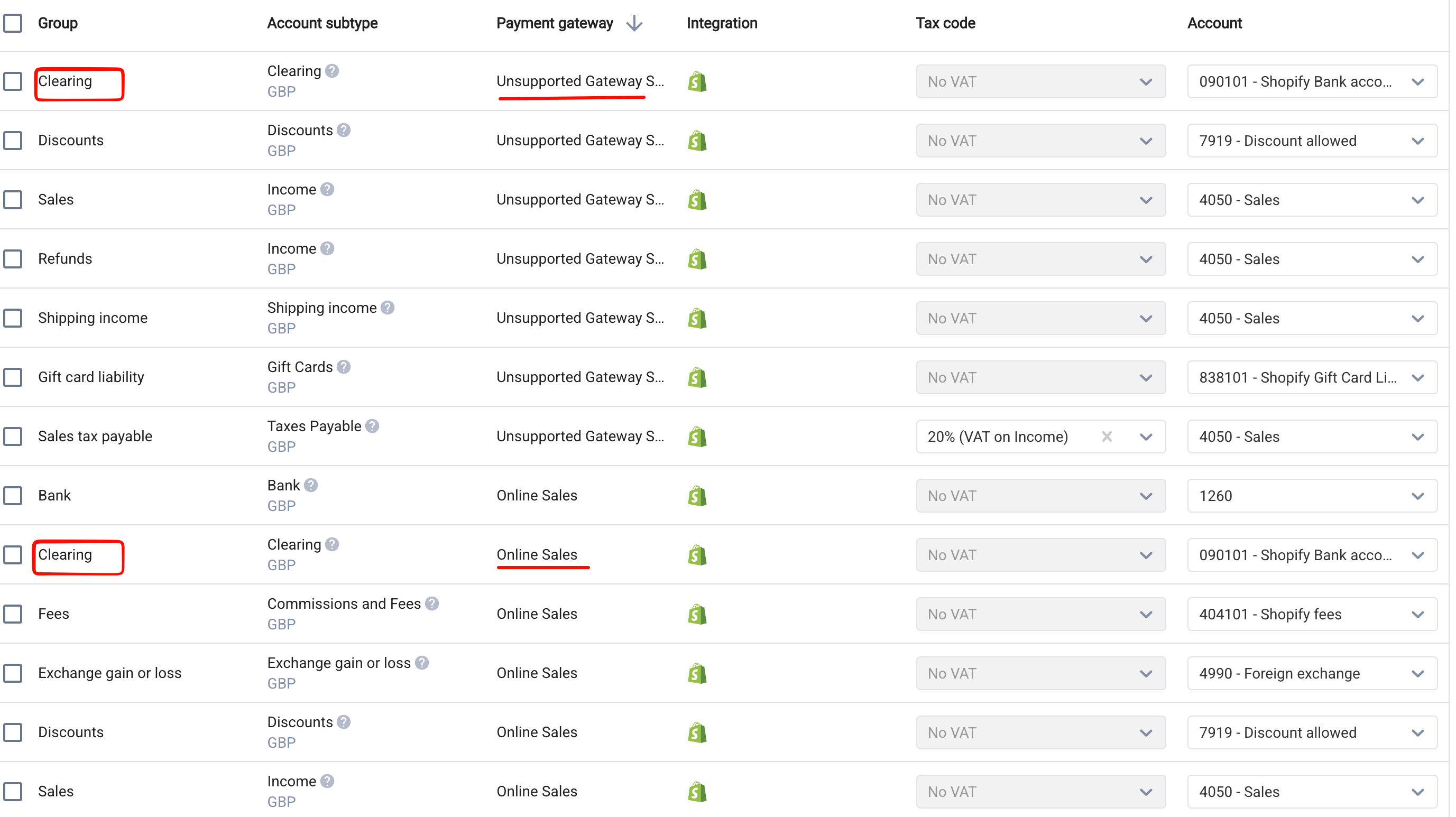
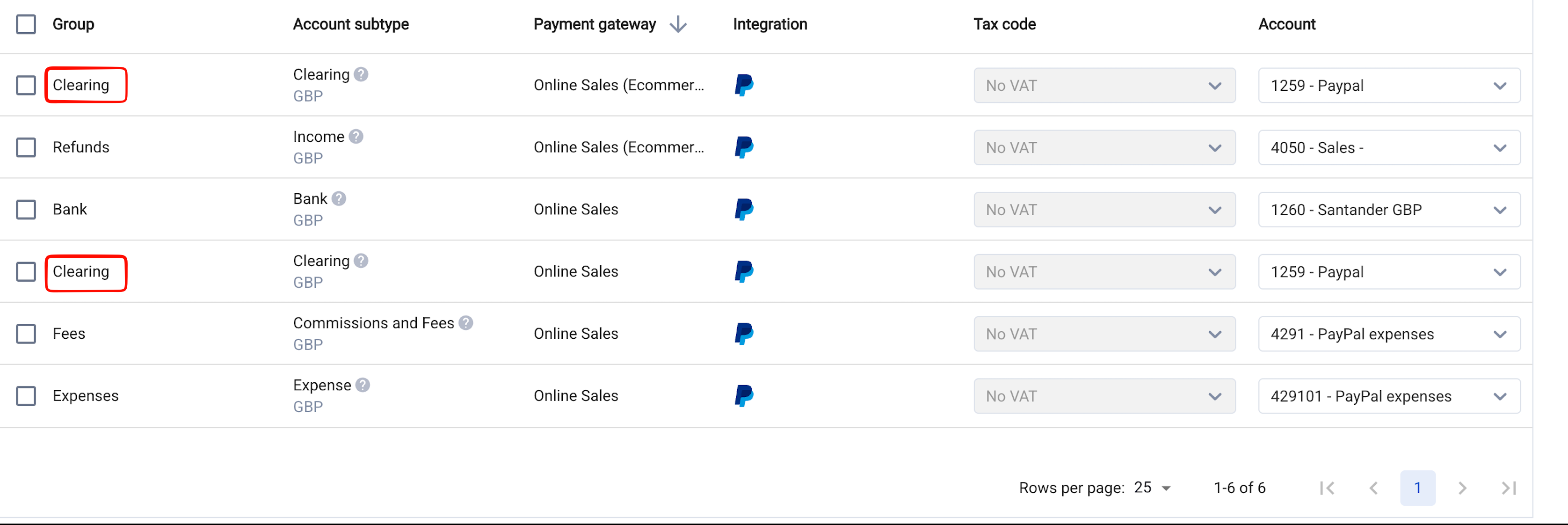
Deep dive: Payouts, Clearing Accounts, and Reconciliation — Comprehensive Guide. If you ever see clearing-account lines in a summary preview that puzzle you, this guide explains why.
2. Classification and categorization
In Summary Sync you shape how revenue is broken out using two levers: how summaries are aggregated and how each summary’s lines are grouped.
Aggregation period. When you set up Summary Sync you choose how often a summary is created — Daily, Per Payout, Monthly, or Manual (custom period).
Per-Payout is the one that makes reconciliation cleanest because each summary matches a bank deposit exactly (available for Amazon, eBay, Shopify, and Stripe, syncing to QuickBooks Online, Sage Intacct, and NetSuite).
See Summary Sync: Aggregating Data by Day, Payout, Month, or Custom Periods and How to Manually Generate a Summary.
Grouping. On the Mappings list, click Add group → “Break down by product, SKU, or region” to split each summary’s sales into separate lines. You can break down by product name, SKU, or shipping region — only one grouping method is active at a time. This is how you get channel-, product-, or region-level detail out of a single grouped summary.
- By region: Summary Sync: How to Group Summaries by Region.
- By Location (QuickBooks Online): tag each channel’s summaries with a Location so your P&L breaks down by sales channel — How to Use QuickBooks Locations in Synder Summary Sync.
- By Product Name or SKU – How to group Summaries via Products
- By Custom groups that have unique conditions – Summary Sync: Understanding Mapping Groups
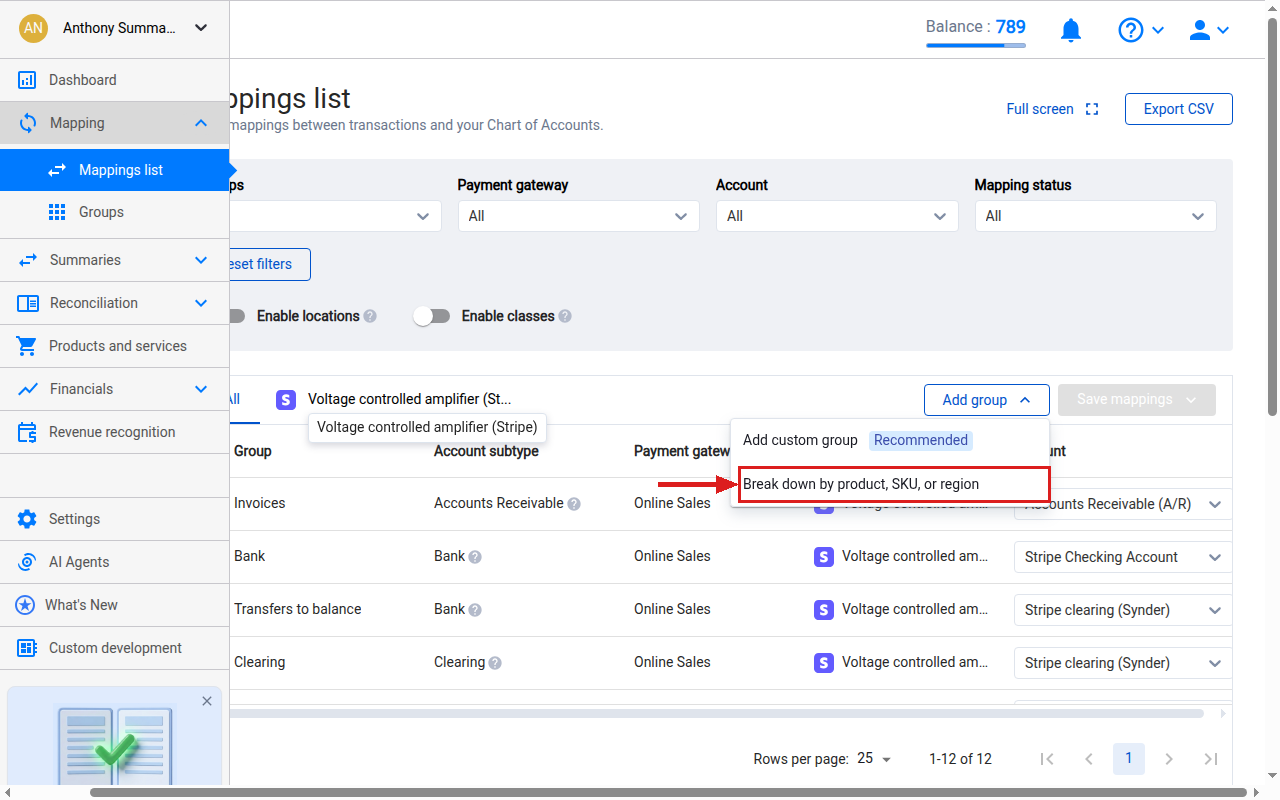
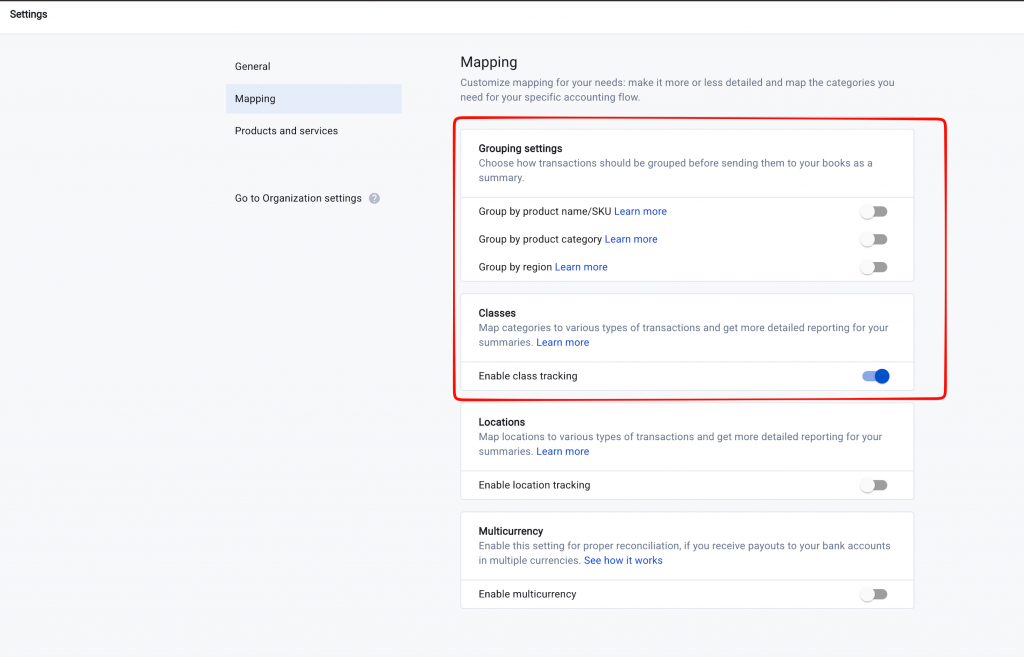
The Mapping settings in one place under the Settings→Mapping: All grouping options, class and location tracking are organization-level switches that apply across all your synced data.
Amazon-specific tip: if you sell both FBA and Amazon Pay, split them into separate summaries or they blend together — how to split them.
3. Taxes
How it is done: Synder does not calculate tax — it records the tax your channel sends. Two things matter for multi-channel sellers:
- Who collected the tax. Marketplaces like Amazon and eBay act as marketplace facilitators — they collect and remit sales tax for you, so that tax should not post as a liability you owe. Tax you collect directly (your own store) is your liability and must be tracked. – See Taxes Withheld
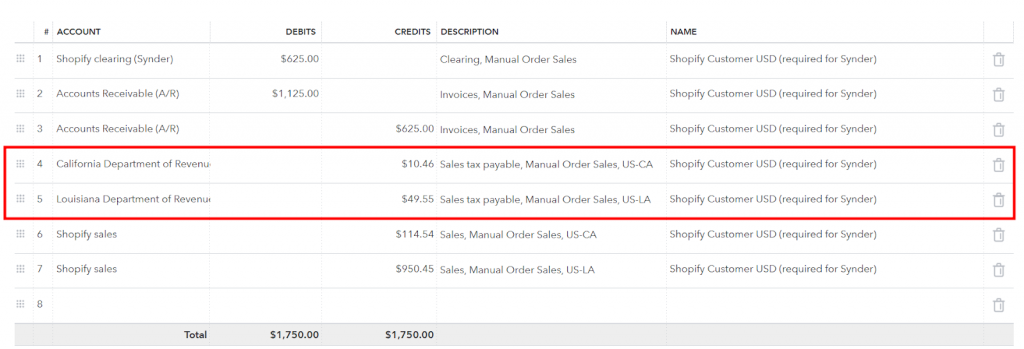
- Multiple tax regions. If you have nexus in several states or provinces, enable Group by region so each summary splits into per-region lines — Sales – US-CA, Taxes Payable – US-NY, and so on — giving you state-level tax tracking and nexus visibility. Region comes from the shipping address; transactions without one appear under “Unknown.” See How to Group Summaries by Region.
For the full tax model and setup, see Global Taxes in Synder: A Guide for QuickBooks Online Users (Xero: Guide for Xero Users). For tracking the tax you do owe in Summary Sync, see Summary Sync: How to Track Sales Tax with Synder.
4. Multicurrency
How it is done: The rule is simpler than it looks. If you have any foreign-currency sales at all, turn multicurrency on. What changes is not whether you enable it, but how many clearing accounts you need — and that depends on how your processor pays you out.
- Sales in several currencies, but the payout arrives in ONE currency. This is the common case. Keep multicurrency enabled — a single clearing account is fine. Synder records each sale in its original currency, then adds a small converting journal entry that moves the foreign activity into your payout-currency clearing account, so a single transfer to your bank still reconciles cleanly.
- Payouts arrive in SEPARATE currencies (into separate bank accounts). Here you need a separate clearing account and checking/bank account per currency, with a strict one-to-one currency mapping. Synder posts a separate summary per currency so each one matches its own foreign-currency deposit.
- Daily Summary mode is fully supported: each daily summary splits into one journal entry per currency, and you reconcile currency by currency.
- It is a global setting, configured from Settings→Mapping. In Summary Sync, multicurrency is turned on once at the organization level — it is not configured per integration.
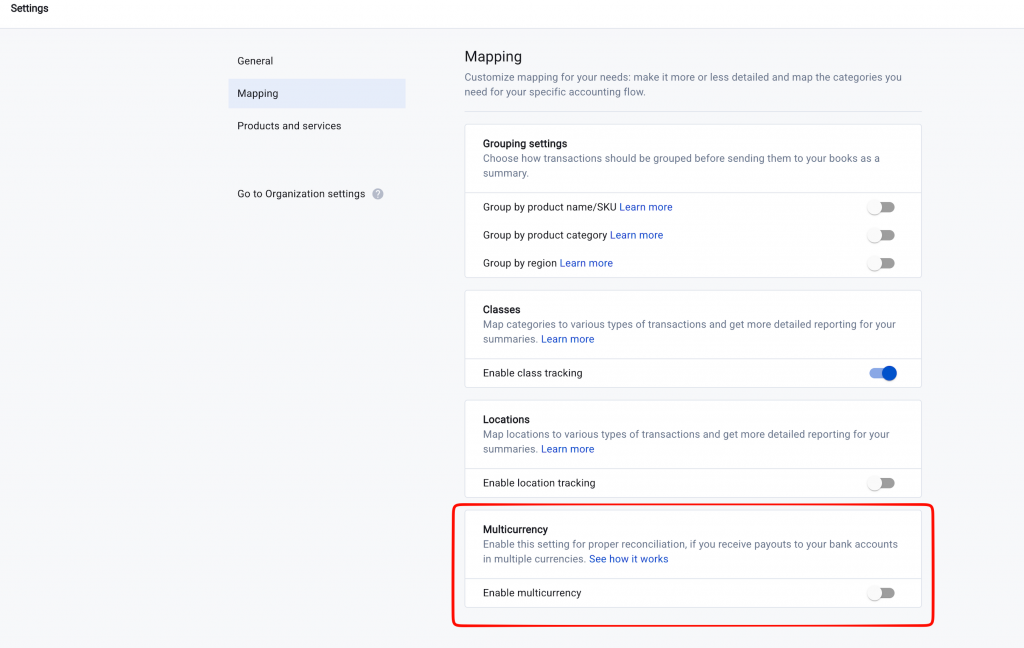
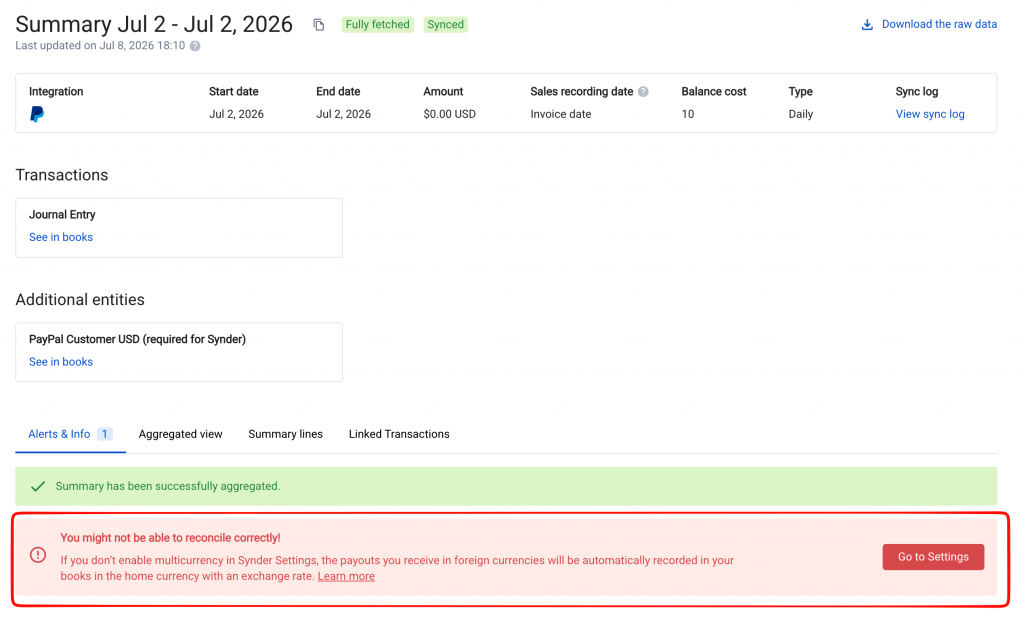
Two things to know before you start. In QuickBooks Online, turning on multicurrency is irreversible, so enable it deliberately. And you cannot sync foreign-currency sales while QBO multicurrency is off — Full detail and examples: Multicurrency transactions in Summary Sync mode.
5. Discrepancy and reconciliation
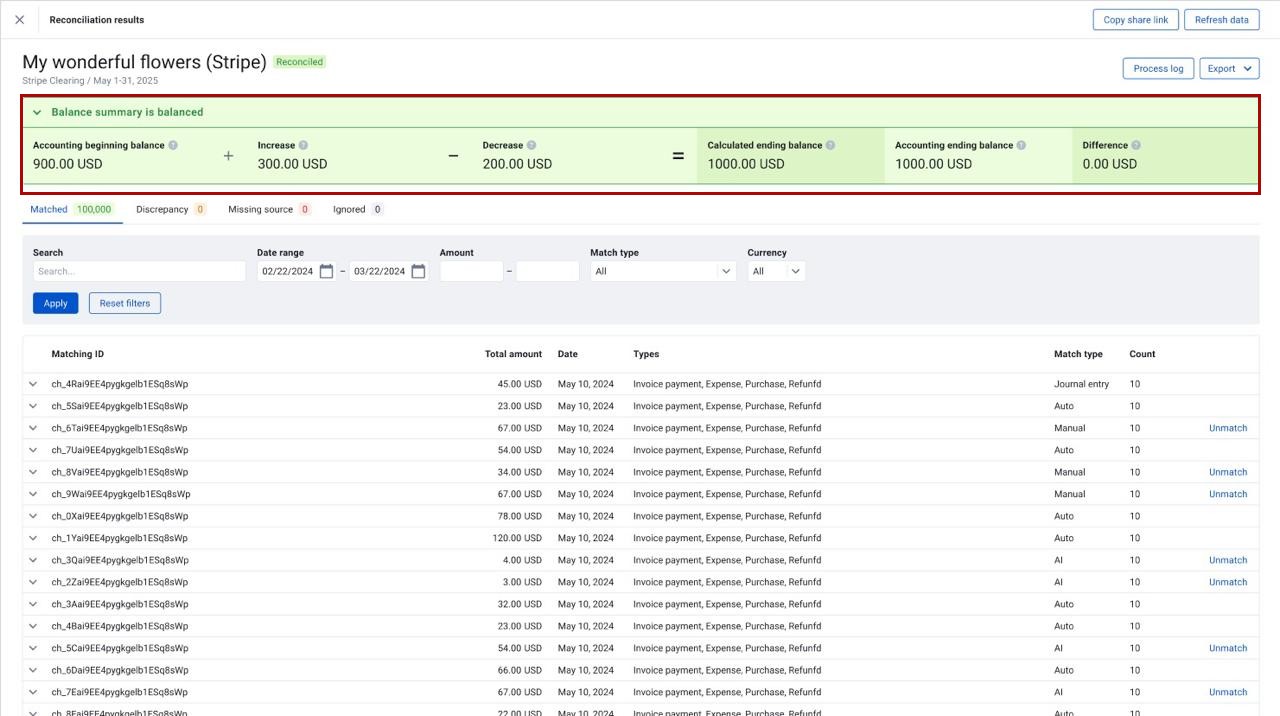
How it is done: After summaries post, each channel’s clearing account should zero out as payouts land. In Summary Sync you validate the data before you sync, then confirm each payout matches its summary:
- Validate before syncing: Summary Sync Transaction Reconciliation: Verify Your Data Before You Sync.
- Match summaries to payouts: Per-Payout aggregation makes each summary equal one deposit — ‘Per Payout’ Synchronization.
- Channels without payout support: How to Reconcile Integrations Without Payout Support.
- Leftover “Unidentified funds”: why the Unidentified Funds line appears.
Putting it together: a multi-channel Summary Sync checklist
- Connect every platform in your money flow with the same import start date; give each channel its own clearing account in its mapping.
- Choose your aggregation period (Per-Payout for the cleanest reconciliation where supported).
- Set up mapping per integration and per gateway (clearing, bank, income, taxes, fees, AR).
- Add grouping (by product/SKU/region) and/or Locations for the breakdown you want.
- Set up taxes: keep facilitator-collected tax separate from tax you owe; enable Group by region for multi-state nexus.
- Enable multicurrency if you have any foreign-currency sales; use one clearing account when the payout is single-currency, or a separate clearing + bank account per currency when payouts arrive in different currencies.
- Validate before syncing; after syncing, confirm each clearing account returns to zero.
Related guides
- Settings Checklist: Configure Synder Before Your First Sync
- Summary Sync for Ecommerce: Things You Need to Know
- How Is Data Collected for Summaries in Synder
- Payouts, Clearing Accounts, and Reconciliation — Comprehensive Guide
- Summary Sync: Aggregating Data by Day, Payout, Month, or Custom Periods
- Summary Sync: Understanding the Mapping Groups
- Summary Sync: How to Group Summaries by Region
- How to Use Locations in Synder Summary Sync
- Global Taxes in Synder: A Guide for QuickBooks Online Users
- How Taxes Withheld by Marketplaces Are Processed with Synder
- Multicurrency Sync for Daily Summaries
- Transaction Reconciliation for Summary Sync: Validate Your Data Before You Sync
- How to Reconcile Integrations Without Payout Support in Synder
- Multi-Channel Selling with Per-Transaction Sync (companion guide)
