
A finance director for a B2B agri-tech company recently asked a question that is faced by many companies as they expand. The company uses Xero, receives most payments through bank transfer and handles a couple of thousand transactions a month. The director asked us: “I am having issues reconciling monthly subscription payments (from the bank) to invoices on Xero and am looking really for an AI tool which can manage this process for me.?
It’s a reasonable question. Large language models (LLMs) can read messy data, identify patterns and increasingly connect to business systems by using things such as Model Context Protocol (MCP). The obvious next question is: why do a finance team need a dedicated sync and reconciliation tool when Claude/ChatGPT can access Stripe, Shopify and QuickBooks simultaneously?
It’s a matter of access versus accounting. Having three systems is different to synchronizing three systems. So let’s discuss how today’s AI assistants helps ecommerce and SaaS accounting, where the line is drawn between a smart assistant and a reliable accounting pipeline and why even companies that are creating AI products need to use tools such as Synder to ensure books remain accurate.
TL;DR
- AI can connect to accounting systems, but it doesn’t automatically keep them reconciled. Accessing Stripe, Shopify, and QuickBooks is one thing; maintaining accurate books is another.
- MCP servers, workflow tools, and custom AI pipelines all require businesses to build and maintain their own accounting logic. None come with reconciliation rules built in.
- Synder handles the accounting complexity that AI models don’t know by default, including payouts, fees, refunds, chargebacks, multi-currency transactions, revenue recognition, and reconciliation workflows.
- The winning combination is AI plus Synder. Let Synder keep the books accurate and synced, and let AI help analyze, summarize, and explain the results.
Three paths to “roll your own” accounting automation with AI
So far, there are three viable approaches for accounting automation based on an AI model. All of them provide businesses with increased access to their own information, but none of them will give you reconciled books by themselves.
Path 1 – Hand stitch MCP servers together
Anthropic’s Model Context Protocol enables an AI model to interact with external tools via a common interface. A business can deploy and register a few servers and directly ask Claude:
- The Stripe MCP server provides the model with charges, customers, subscriptions, refunds, and invoices.
- Orders, Products, Customers, and Collections are exposed by a Shopify MCP server through Composio.
- Intuit’s QuickBooks Online MCP server has access for QuickBooks entries (read and write). Currently, Intuit’s first-party server is a developer tool (early preview) and is not yet a sync endpoint.
A person can then enter: “Look at Stripe charges from yesterday and match them to Shopify orders and post the matching entries to QuickBooks” as all three are connected. The model will try to do it.
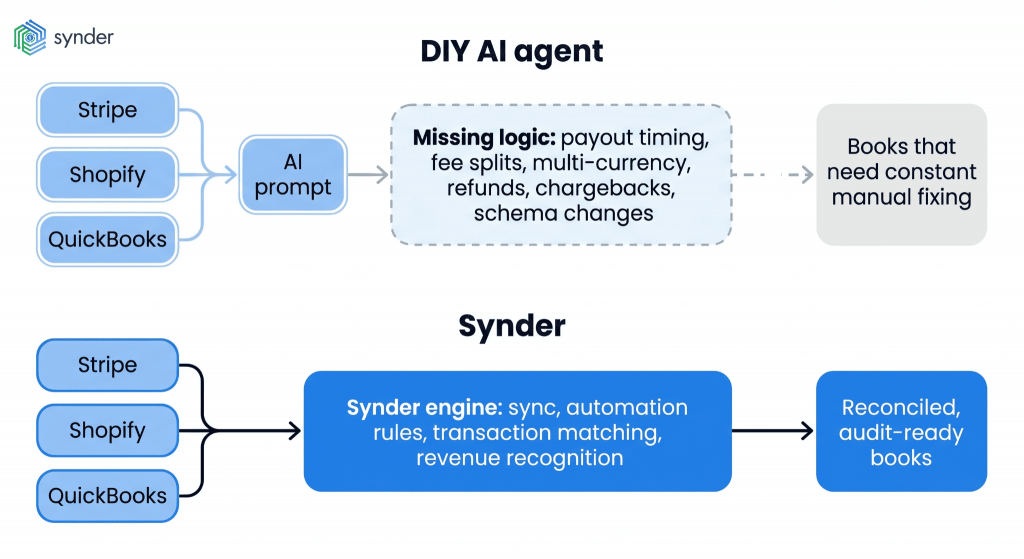
This is where access and reconciliation are two different worlds. An AI agent will only start to act if someone asks it to. There are no scheduled syncs. It just can’t automatically know that you pay Stripe after fees, and that it can take 2 days for a customer to pay and then it to arrive in your bank account.
A simple prompt will also not cover items such as multi currency settlements, refunds, chargebacks and fee splits. If one platform reports a different number for the same sale than the other, the agent doesn’t have any rules built in to take care of it. However, if some API error or API rate limit occurs in the process there is no automatic retrial.
| It means the model is technically capable of accessing all three systems. But every time there’s a need for an answer, someone still has to run the process and interpret the results. This is a manual process assisted by AI, not a sync. |
Learn working prompts for Chat GPT accounting.
Path 2 – Workflow automation with a Claude node (n8n, Make, Zapier)
Automation platforms such as n8n, Make, Zapier, Albato, and Latenode let businesses build workflows with AI built in. For example, when a Shopify order comes in, a workflow can update inventory, send a confirmation email, and create a QuickBooks invoice. When a Stripe payment arrives, another workflow can find the matching invoice and mark it as paid.
This gets much closer to a sync because it runs automatically. For simple workflows, it can work very well. The business still has to decide how everything works: what data to pull, how fields should map, what happens with refunds, how payouts are recorded, and where fees belong.
As the accounting becomes more involved, so do the workflows. If Stripe and Shopify show different numbers for the same transaction, someone has to decide how that difference should be handled and build the logic accordingly. And when platforms update their APIs or data structures, the workflows often need updating too. Multi-currency transactions, payout timing differences, FBA fees, and chargebacks can all be managed, but only if those rules have been built into the flow and kept current.
Path 3 – Custom code with the Claude API and provider SDKs
The most flexible is to construct it yourself. A developer can write code that fetches data from Stripe and Shopify, feeds it into Claude for classification, and then push all of the data into QuickBooks.
You have full control, however you also have full responsibility about keeping everything going. When an API changes, if it breaks, a job fails, or a new fee type comes out, someone has to repair it! Everything from multi-currency transactions to refunds, chargebacks, how long it takes to pay out, etc. all must be worked out in the code.
But in practice, it’s no longer about merely plugging in some apps. You have an accounting data pipeline that you’re developing and maintaining. All the accounting rules that a sync tool like the one you are developing knows have to be developed, tested and updated by your team.
Each of the three methods provides a certain degree of control, and all three methods do not necessarily resolve reconciliation problems independently:
| Stitched MCP servers | Workflow automation node | Custom code pipeline | |
| Runs on a schedule | No, only when prompted | Yes, on a trigger | Yes, if you build it |
| Field mapping and fee logic | Manual, every run | You design all of it | You code all of it |
| Reconciliation logic built in | None | None | None |
| Survives a platform schema change | No | Breaks until rewritten | Breaks until rewritten |
| Multi-currency, payouts, chargebacks | Not handled | Only if hand-coded | Only if hand-coded |
| Ongoing maintenance owner | You | You | You |
Learn if AI will replace accountants in the near future.
The cleanup logic AI does not have
In January 2026, Blake Oliver, CPA, gave an excellent summary on LinkedIn of today’s status of AI. He compared AI to a “really smart intern” – helpful, quick, and enthusiastic, but lacking in context, judgment, and experience to deal with all situations properly.
His arguments were:
AI is powerful, but it is missing a lot of context that humans have access to. Providing it with all the necessary context takes a lot of effort.
There aren’t a lot of integrations with accounting software, meaning the time we save is often lost to copy/paste between systems.
Models are ‘black boxes,’ meaning no one really knows how these models work. That makes their work difficult to audit.
Blake Oliver, CPA
While AI can assist with much, it cannot do anything if you don’t tell it what to do. Adding the necessary background details can be a considerable challenge. Even today, many accounting systems aren’t heavily integrated with AI tools, and the hours saved in analysis can be lost through the process of copying and pasting data. The outputs of AI models are still largely black boxes, and are hard to audit and explain.
So, what really does a general-purpose AI model lack in comparison to a specialized accounting system?
Quite a bit, indeed.
- For instance, if you get paid by Stripe, it will be a net payment, maybe two days after the initial payment. It must be separated correctly into revenue, fees and actual bank deposit to reconcile properly.
- Shopify and Stripe will record the same sale in different ways if Shop Pay is used.
- Amazon FBA fees are of various types and each one of these could be categorized into a separate account.
- A chargeback involves canceling the initial entry and making a separate dispute entry.
- For multi-channel sellers, it’s important to have revenue attributed to channels, by knowing which Stripe charge came from which channel.
- Summary sync and per-transaction sync are two different flows and have different reconciliation patterns. And dedicated solutions like Synder apply these patterns.
Such knowledge is not built into Claude, ChatGPT, or any other model. They are good reasoners, but lack years of edge cases and rules about accounting.
This is why companies like Synder that develop their own solutions end up with a large repository of accounting logic, in addition to their code. Those rules need to be kept in step with the evolution of Stripe, Shopify, Amazon and accounting platforms. The logic has been built up and refined over years, and tools like Synder keep it current as platforms evolve, so businesses can focus on their books instead of learning the latest API changes.
Where AI actually helps in accounting (and where it does not)
AI is making its way and mark in finance, and it’s important to be precise about where. Synder’s own research on finance automation in 2025, which surveyed 424 senior finance professionals from ecommerce and SaaS businesses, showed that over half of teams currently use LLM for financial reporting and anomaly detection, while less than 20% are leveraging it for forecasting and scenario modeling. The power of an AI model is its ability to rapidly convert high-volume, unstructured data into readable insights: regulatory summaries, anomaly flags, financial narratives, custom report drafts.
The downside is that it relies on the numbers themselves, and that’s where finance teams feel it the most. An omni-channel seller who sells on TikTok, Shopify, Amazon and Quickbooks Online spoke with a Synder representative and told him he didn’t want reports generated using AI because he didn’t feel they were accurate, and inquired about the backend of the platform. Another customer expressed the same concern about an AI reporting feature’s accuracy when trying to sell on Amazon and WooCommerce.
And this is not a surprise. The trustworthiness of an AI narrative depends on the underlying ledger, and if it’s generated by an unsupervised prompt, the narrative will contain any underlying reconciliation errors found in the prompt.
What really holds up is this is the division of work. Have AI read, summarize, and report insights on clean books. Build clean books on a dedicated system whose job is correctness, scheduled execution, and an audit trail. The first depends on the second.
| AI handles this well | AI should not own this |
| Generating financial summaries | Reconciling sales against payouts |
| Flagging anomalies in a ledger | Splitting gross revenue, fees, and deposits |
| Drafting compliance narratives | Routing multi-channel revenue by source |
| Answering plain-language questions about data | Recording chargebacks and cross-currency refunds |
| Producing custom report drafts | Running on a schedule with an audit trail |
How Synder uses AI
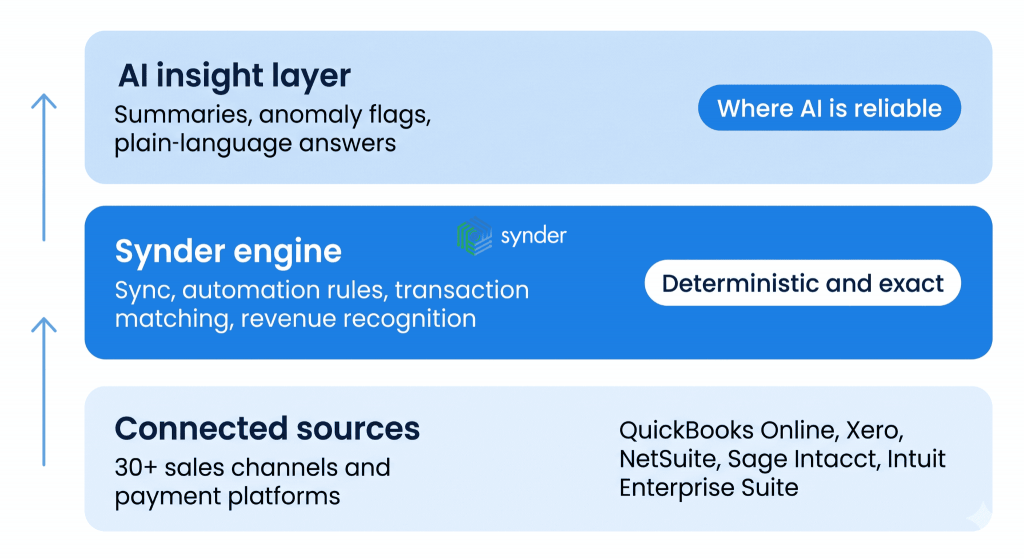
Synder is not anti-AI. It is a smart accounting platform that leverages AI where AI makes sense and where the calculations require precision. A company that graduated from both YCombinator and AICPA Startup Accelerator, Synder connects over 30 sales channels and payment providers to QuickBooks, Xero, NetSuite, Sage Intacct, and Intuit Enterprise Suite and automates multi-source integration, multi-channel reconciliations, and GAAP-compliant revenue recognition.
At the core of the system lies an accounting engine based on rules. This is how you end up with the books that the CFO can endorse.
- Synder’s customizable Smart Rules automatically classify all kinds of fees in complex fee structures, so that, say, for an Amazon seller, each of the stocking, transaction, marketing, and restocking fees goes to its own account, without someone manually classifying them.
- Transaction Reconciliation cross-verifies transactions as a second layer of processing.
- Revenue recognition allocates the revenue from subscriptions based on an exact time schedule, not an approximation.
Only after having this clean data, AI comes into play as a reporting and analytics tool. And this is exactly the technology stack that the research highlights – accurate transaction processing for the books and natural language for the narrative.
Who DIY-AI actually makes sense for
In some cases, creating an AI tooling makes sense. It works best when the project is not related to integration with online accounting.
For example, one property management team detailed they had automated their rent collection with Buildium, while vendor invoices, tax bills and utilities are still managed manually. Individual, unique needs are ideal for custom AI solutions because one-size-fits-all sync solutions aren’t effective for every specific task.
Now, the situation changes if recurring accounting work comes into play:
- Even for sellers who only use Stripe, there’s still a lot of difficulty and a lot of refunds happening every week. It becomes cumbersome to do this by hand.
- When a larger business has several platforms and is handling a big sale, they end up re-building capabilities that can be provided by a professional service. Not to mention, they typically miss out on a lot of rare problems initially, which results in expensive mistakes and endless debugging.
- Accountants who manage clients’ finances need something reliable, regular, and traceable. Custom-made tools often fall short here.
To sum up, custom AI is beneficial for one-off unique tasks and reliable platforms excel at repetitive financial syncing and recon tasks.
Even AI-native companies use Synder
The best indications are provided by the companies that have the deepest understanding of AI. Dozens of Synder customers currently run .ai sites and many of them create AI agents, bookkeeping models, and automation platforms for a living. The teams that would’ve done it if it was the obvious thing to do were to roll their own AI accounting agent. They host their books on Synder, however.
The list is populated with a who’s who of applied AI:
| Company | What they build |
| Zeni | AI bookkeeping for startups |
| Proper | AI bookkeeping for accounting firms |
| LedgerUp | AI-led ledger automation |
| Relevance AI | A platform for building AI agents |
| AssemblyAI | A leading speech-to-text API |
| Inworld | AI characters for games |
Outside of that, the paying customers who use these technologies are in the AI healthcare and clinical documentation, AI sales and marketing, AI real estate, AI logistics and delivery, AI voice and conversation, AI design and media, and AI research and safety sectors.
These teams are not lacking in skills when it comes to wiring up MCP servers or writing a sync pipeline. They have selected to not invest their engineering time in re-building accounting logic that is already in place and is maintained.
Their logic is in alignment with the logic that Synder hears in sales conversations with finance leaders who are native to AI. The finance lead for a voice-AI SaaS for restaurants required automated sync to maintain line-level service periods for accurate allocation, included deferred revenue for monthly & quarterly plans, and included credit notes, location-based taxes, and discounts.
The finance lead of an ad-tech and AI-education company, who had been manually reconciling Stripe and Paypal to Xero, wanted something which would automate and summarise daily and weekly transactions, including multi-currency and chargebacks/rewards and refunds. A prompt isn’t a device you want doing those chores. They’re exactly the kind of thing that Synder does on a daily, on-schedule, audit-trail basis.
| If you are weighing an AI agent against a dedicated sync tool, the fastest way to see the difference is to run your own data through both. Book a demo with Synder and have the team map your reconciliation flow with you. |
The bottom line – what AI can and cannot do for accounting today
AI is not the obstacle that prevents a finance team from having clean books. It’s a good layer to read, summarize and explain, and it improves at them quarterly. What it doesn’t provide is the logic behind it: rules to split a Stripe payout into a revenue, fees and deposit; a way to route an Amazon disposal fee away from a storage fee or to reverse an entry when the chargeback arrives. Create your own rules and you’ll keep up with the rule changes from Stripe, Shopify, Amazon and your accounting software.
A prompted model can get to your systems and a special platform keeps them in sync with you, keeping them connected and aligned over time. Synder focuses on that second piece, using AI for insights and automation where it makes sense, while relying on proven accounting logic for the parts that need to be right every time.
Point AI at the one-off, unstructured tasks that it excels at, and let a system that is just there to get it right close the books every period.
FAQ
Can ChatGPT or Claude connect directly to QuickBooks and Stripe?
Yes, via the MCP servers. There are multiple MCP connections available and/or supported by Stripe, Shopify, and Intuit, all of which allow a model to read and/or write data. But, reconciliation is not a connection. The model can be used to access the data, but does not provide any accounting logic, does not allow the model to be scheduled, and does not provide any guarantee of the data being synced across the systems unless a person builds and maintains that logic around the model.
Is it cheaper to build my own AI accounting agent than to pay for a sync tool?
Sometimes (and only sometimes) when volume and edge cases are at stake. That’s just the beginning of the build. All of this becomes continuous engineering work and the edge cases come.All of this becomes a continuous engineering task and edge cases creep in. Most teams spend more time engineering than the time it takes to get the system to work for their regular cases before a dedicated tool becomes cheaper.
What can AI do well in accounting today?
AI is excellent for reading and summarizing data: creating financial summaries, identifying data anomalies, writing compliance narratives, answering simple questions about data you give it. It is less effective at creating the reconciled ledger below, where rule-based automation should be implemented.
Does Synder use AI?
Yes, as a layer on top of a rule-driven accounting engine. Then with deterministic logic, Synder syncs, categorizes, reconciles and recognizes revenue with precision so you have a complete set of accurate books, and with AI on top of those clean books.
When does building your own AI tooling actually make sense?
Where the work is non-recurring, non-structured and not a result of an ecommerce-to-accounting sync, such as one-off vendor invoices, tax bills, or utility documents from a myriad of sources. A maintained sync platform is a better option for recurring accounting that needs to be synced across various channels on a periodic basis.