

Overview
After connecting your company and accounts, configure the Shopify – QuickBooks Online integration settings. These settings determine how transactions, invoices, fees, expenses, and payouts are recorded in QuickBooks Online.
The Shopify settings are organized into the following sections:
- General settings
- Sales
- Invoices
- Products/Services
- Product mapping
- Taxes
- Fees
- Payouts
- Multicurrency
- Additional settings
Plan availability:
- * Available from the Essential plan and higher
- ** Premium feature available only on Pro and Premium plans
How to Access Shopify Settings
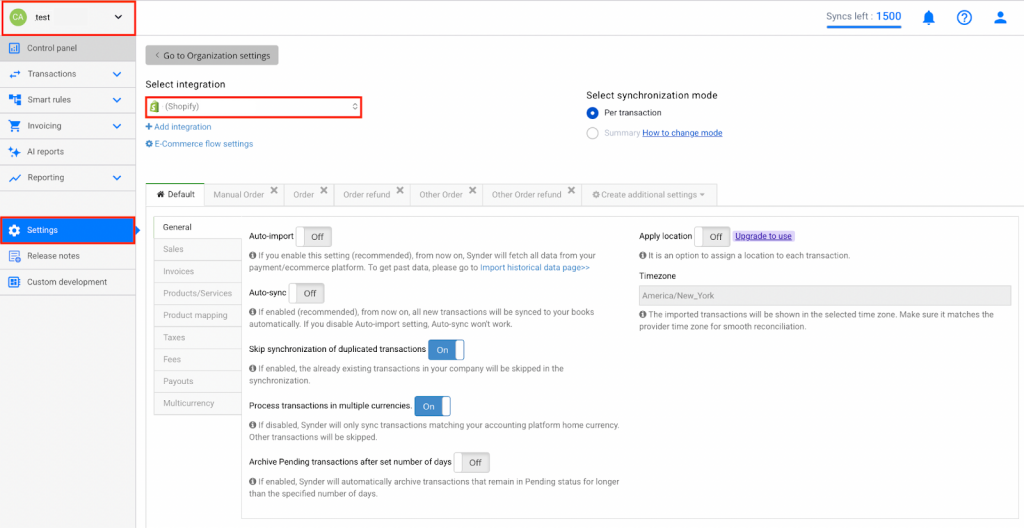
To access your Shopify settings in Synder:
Option 1: From the main menu
- Select the appropriate organization from the top-left corner
- Click Settings in the left-hand menu
- Choose Shopify from the dropdown list
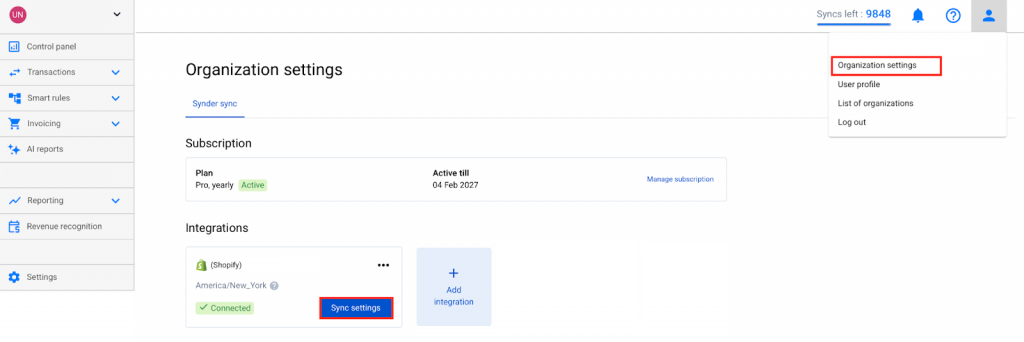
Option 2: From Organization Settings
- Click the person icon in the upper-right corner
- Select Organization settings
- Click Sync settings under Shopify
1. General settings
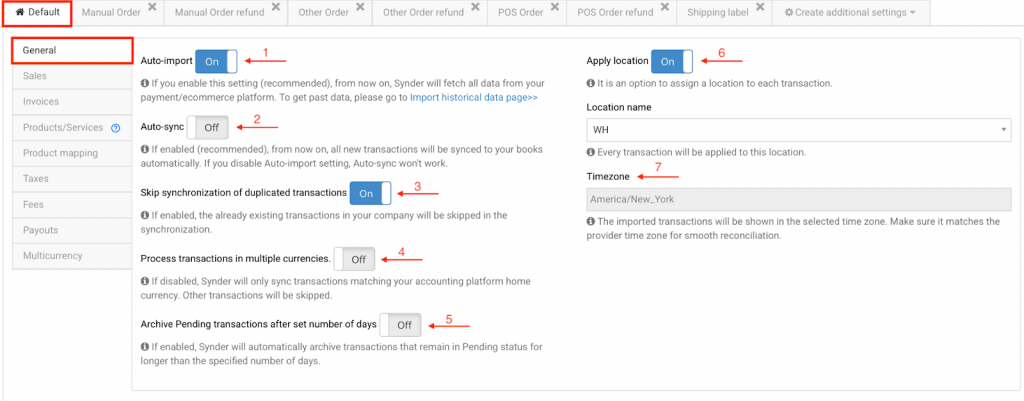
- Auto-Import – Enables Synder to import transactions from Shopify automatically without affecting your sync balance or syncing them to QuickBooks Online. Disable this setting to import transactions manually.
- Auto-Sync – Enables Synder to sync transactions automatically after import. Disable this setting to sync transactions manually from the Platform Transactions tab.
- Skip Synchronization for Duplicated Transactions – Prevents syncing of transactions that already exist in QuickBooks Online with the same ID.
- Process Transactions in Multiple Currencies – Enables syncing of all transactions regardless of currency. Disable this setting to sync only transactions in your home currency.
- Automatically Archive Pending Transactions – Removes pending transactions that were never finalized on Shopify. To archive manually, go to the Platform Transactions tab, locate the transaction, click the three dots, and select Archive.
- Apply Location – Assign a QuickBooks Online location to synced transactions. Enable this setting and select a location.
- Timezone – Displays your Shopify account timezone to align transaction dates between Shopify and QuickBooks Online.
2. Sales
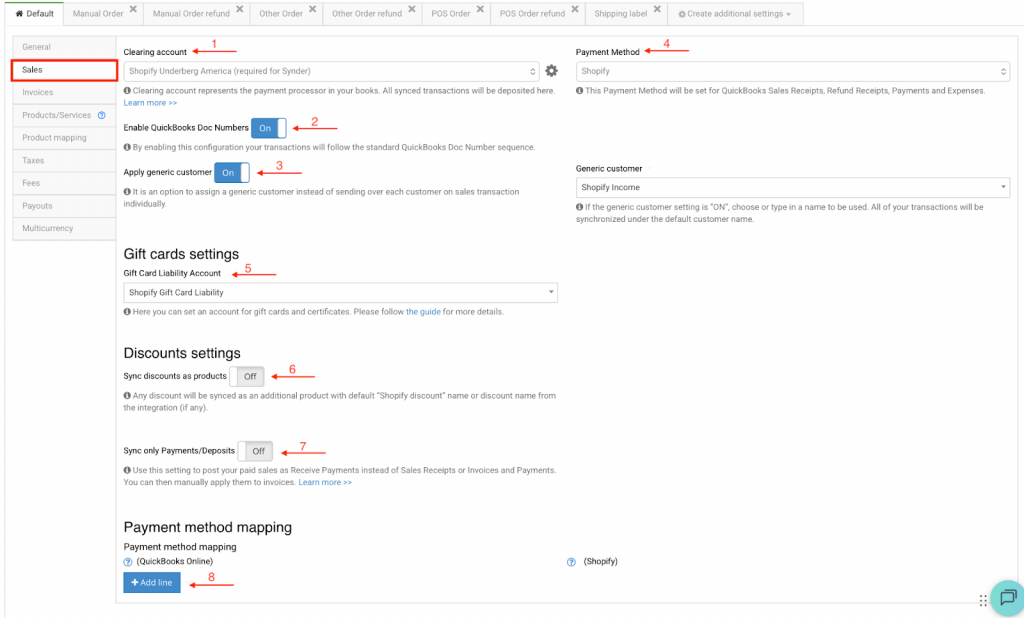
- Clearing Account – A buffer account where QuickBooks Online sales receipts, refund receipts, and payments are deposited before transfer to main accounts.
- Enable QuickBooks Doc Numbers – When enabled, transactions follow the standard QuickBooks document numbering sequence. When disabled, Synder assigns the DocNumber based on the payment processor number.
- Apply Generic Customer – Assigns a single customer name to all transactions to maintain a consolidated customer list in QuickBooks Online. Select or enter a default name, such as “Shopify Customer.”
- Payment Method – Select the default payment method (cash, check, credit card, or Shopify) used for sales receipts, refund receipts, payments, and expenses.
- Gift Card Liability Account – Select the account used to record gift cards and certificates. Refer to How to Account for Gift Card Sales Using Synder.
- Sync Discounts as Products – Sync discounts as separate products, such as “Shopify Discount,” to enable detailed tracking in the Profit and Loss report.
- Sync Only Payments/Deposits – Record order-related payments as Receive Payments instead of Sales Receipts or Invoices and Payments. Apply the payments to invoices manually. Refer to Syncing Shopify Payments as Deposits/Overpayments.
- Payment Method Mapping – Synder retrieves the payment method used in Shopify and includes it in the transaction description. Use this information to map the corresponding payment method in QuickBooks Online.
3. Invoices
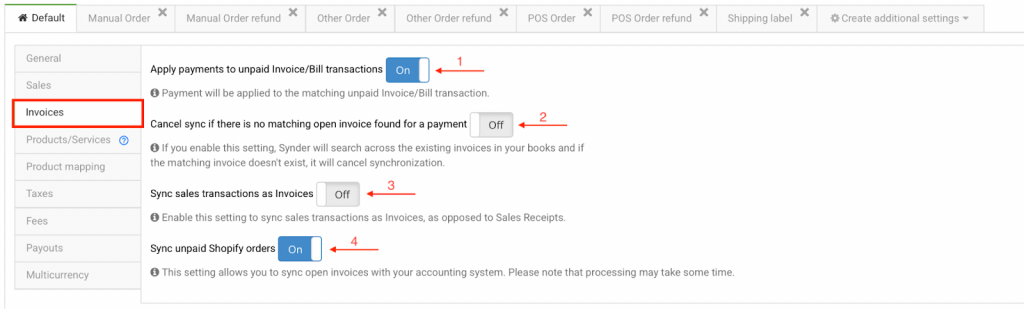
- Apply payments to unpaid Invoice/Bill transactions – When enabled, payments that match an unpaid invoice are applied automatically, closing the invoice.
- Cancel sync if there is no matching open invoice found for a payment – Payments that do not match any open invoice will not sync, preventing incorrect entries.
- Sync sales transactions as invoices – Enable to sync sales transactions as Invoices instead of Sales Receipts.
- Sync unpaid Shopify orders – Enable to sync open invoices with the accounting system. Processing may take time.
4. Products and Services
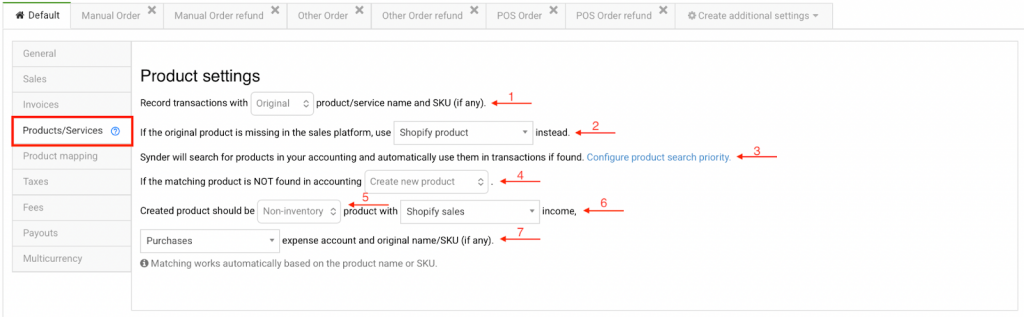
- Record transactions with Original/Common product/service name and SKU – Select whether Synder records transactions using the original product name or a common product name. Synder matches original names to existing products in your accounting software by name or SKU. If no match is found, Synder creates a new product. Common product names help standardize future transactions.
- If original product is missing – If the original product is missing on the sales platform, Synder uses the selected item or SKU.
- Configure product search priority – Set whether Synder searches by SKU or product name first when matching products between Shopify and QuickBooks Online. Refer to Product Search Priority.
- If the matching product is not found* – If a product match does not exist in QuickBooks Online, Synder can either create a new product or cancel the transaction sync.
- Assign product type – Select the product type for newly created items: Non-inventory, Inventory, or Service. Refer to the inventory section for details.
- Assign income account – Select the income account to be used for this product.
- Assign expense account – Select the expense account to be used for this product.
Inventory
Synder supports inventory tracking for items that already exist in QuickBooks Online. Inventory item names must exactly match the names in your payment processor. Synder cannot create inventory items because QuickBooks Online requires a starting stock level (Quantity on Hand), which Synder cannot access. Existing inventory items will sync correctly, and QuickBooks Online will update their stock levels automatically. Refer to Managing Products and Services with Synder – Per Transaction Sync.
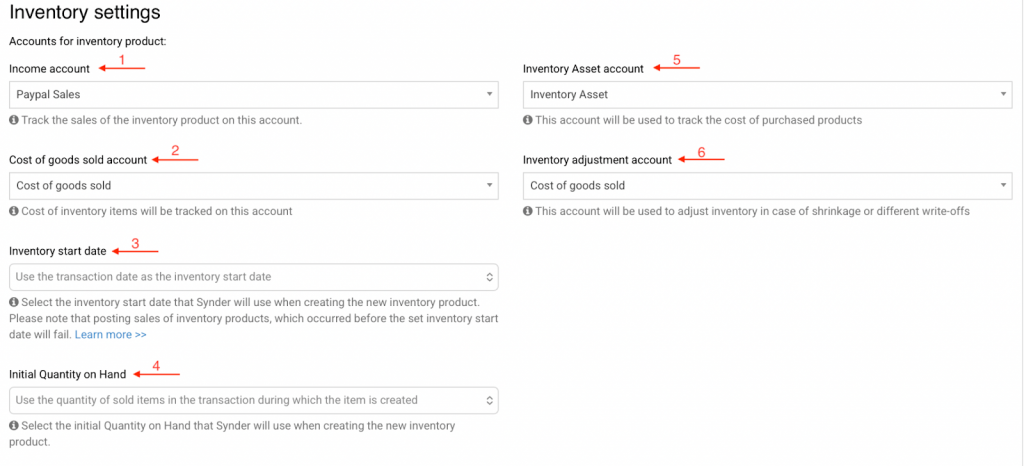
- Income Account – Select an income account to track sales for the inventory product.
- Cost of Goods Sold (COGS) Account – Select a COGS account to track costs for the inventory product.
- Inventory Start Date – Select the start date Synder will use when creating the inventory product. Sales of inventory products that occurred before this date will not post.
- Initial Quantity on Hand – Select the initial Quantity on Hand for the inventory product.
- Inventory Asset Account – Select an inventory asset account to track the cost of purchased products.
- Inventory Adjustment Account – Select an inventory adjustment account to track shrinkage or other write-offs.
5. Product mapping *
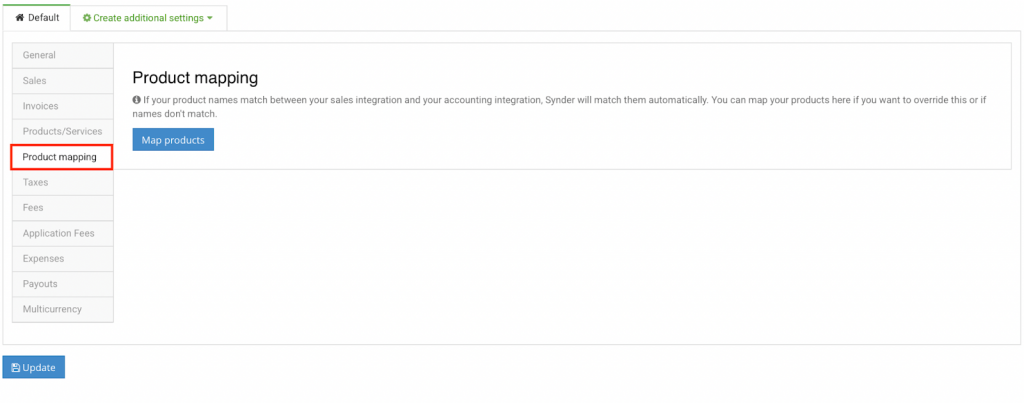
Synder identifies existing products in your accounting company and applies them to transactions. If product names in your payment platform do not exactly match those in QuickBooks Online, enter the payment platform product names in the right field to map them to the corresponding QuickBooks Online product names in the left field. Refer to Product mapping feature.
6. Taxes tab settings
Sales Tax Settings for U.S.-Based QuickBooks Online Companies
Most U.S.-based QuickBooks Online companies use Automated Sales Tax. This feature applies sales tax automatically based on the sale or company address. QuickBooks Online calculates the tax rate automatically.
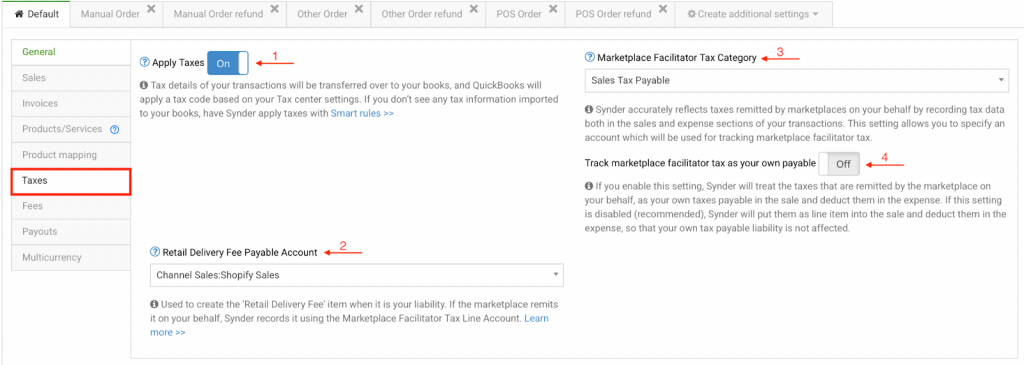
- Apply Taxes – Enable this setting to have Synder record taxes in the tax field for accurate reporting. Disable this setting to record taxes as a line item.
- Retail Delivery Fee Payable Account – Use this setting to create the “Retail Delivery Fee” item when it is a liability. If the marketplace remits the fee on your behalf, Synder records it using the Marketplace Facilitator Tax Line Account. Refer to Retail Delivery Fee.
- Marketplace Facilitator Tax Category – Synder records marketplace-remitted taxes in both the sales and expense sections of transactions. Use this setting to select the account for tracking marketplace facilitator tax. Refer to Marketplace Facilitator Tax.
- Track marketplace facilitator tax as your own payable – When enabled, Synder records marketplace-remitted taxes as tax payable on the sale and deducts them as an expense. When disabled, Synder records these taxes as a line item on the sale and deducts them as an expense without affecting tax payable. Refer to Marketplace Facilitator Tax.
Sales Tax Settings for Non-US QuickBooks Companies
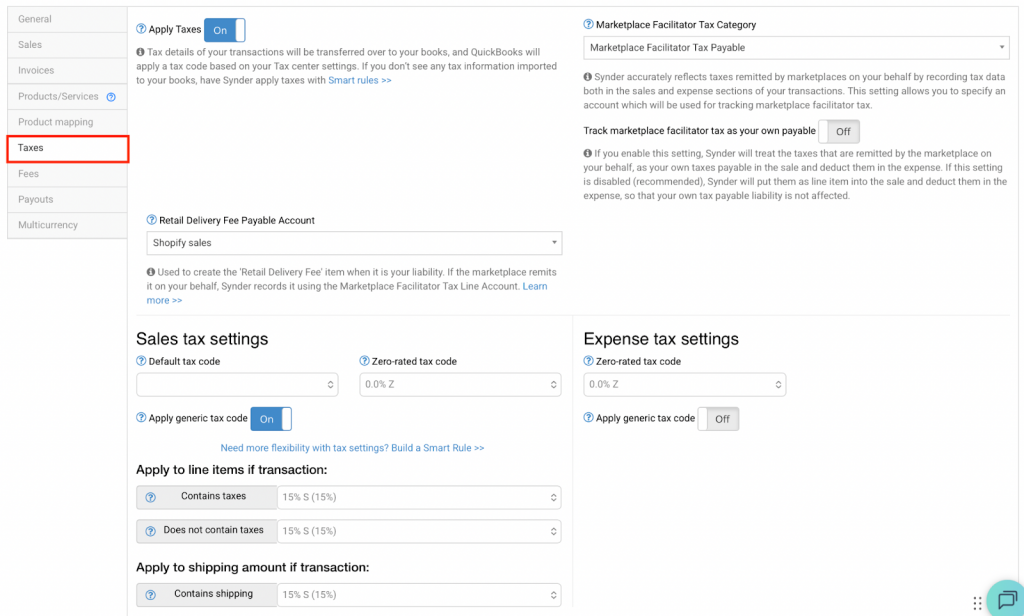
If your payment processor calculates taxes, Synder records them automatically in QuickBooks Online. If the payment processor (for example, Stripe, Square, or PayPal) does not calculate taxes, configure Synder tax settings to apply and record taxes in QuickBooks Online.
Refer to How sales tax works in Synder.
7. Fees
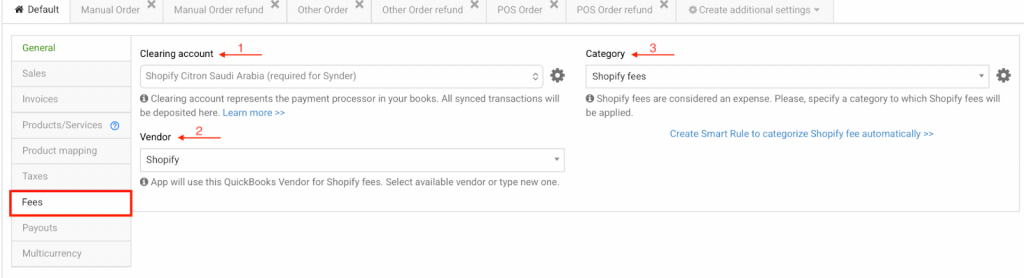
- Clearing Account – Select the clearing account where Shopify fees are recorded. Use the same account as the Sales clearing account to maintain consistency across related transactions.
- Vendor – Select a QuickBooks Online vendor to assign Shopify fees. Choose an existing vendor or enter a custom name to consolidate all Shopify fees under a single vendor.
- Category – Select the expense category in QuickBooks Online for Shopify fees to track and report processing costs accurately.
8. Payouts
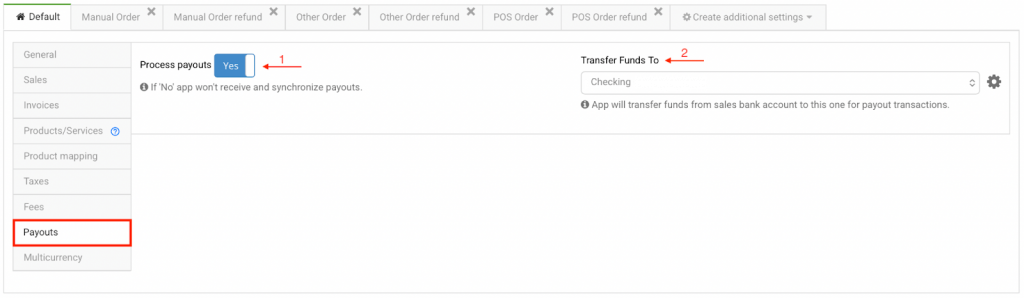
The Payouts tab tracks Shopify payouts, which are bulk transfers from your payment processor to your bank (daily, weekly, monthly, etc.). Synder records these as transfers from the clearing account to the checking account. Syncing payouts with sales and expenses ensures accurate cash flow tracking and simplifies reconciliation.
- Process payouts – When enabled, Synder tracks Shopify payouts and creates transfers to the checking account. When disabled, payouts are not synced, and the clearing account is not cleared automatically.
- Transfer Funds To – Select the QuickBooks Online checking account for Shopify payout deposits.
9. Multicurrency
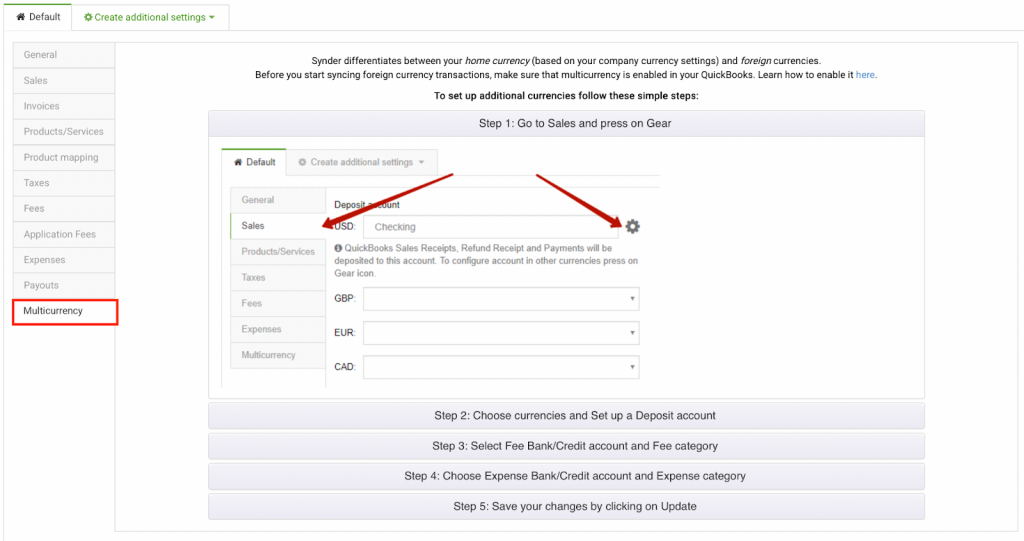
Synder supports multi-currency. The application does not perform currency conversions. Instead, it transfers conversion rates from your payment processor to QuickBooks Online to maintain accuracy. Conversion rates may differ between QuickBooks Online and Shopify on the same day; recording the rate from the original source is required.
Multi-currency is automatically enabled in Synder if it is enabled in QuickBooks Online. Configure accounts to reflect actual money flow. For example, use separate checking accounts if payouts occur in different currencies. Payouts typically occur in a single currency, while sales may occur in multiple currencies.
To customize multi-currency settings, refer to the Multicurrency tab and Synchronize Multicurrency Transactions in QuickBooks Correctly guide.
10. Additional settings
Use the Create Additional Settings option to categorize transaction types. Synder cannot process POS Order, POS Order Refund, Manual Order, Manual Order Refund, Other Order, or Other Order Refund transactions unless the corresponding settings are enabled. Ensure that settings are enabled or disabled on all tabs, not only the default tab. See the relevant guides for details:
How to Sync Shopify POS Orders and POS Order Refunds,
How to Sync Shopify Manual Orders and Manual Order Refunds.
Reach out to Synder Team via online support chat or email with any questions you have – we are always happy to help you!
