



If you’re searching for a QuickBooks POS system, you should know that Intuit discontinued its own point-of-sale software. QuickBooks Desktop POS 19.0 was shut down with no successor, security patches, or future versions. Connected services went dark the same day.
Luckily, most modern POS systems now integrate directly with QuickBooks Online through native apps or connecting tools, syncing sales, taxes, inventory, and fees automatically. In many cases, these alternatives are more capable than what Intuit offered natively.
This article covers which POS systems integrate best with QuickBooks in 2026, what that integration does for your books, how to set it up, and what to watch for so your reconciliation doesn’t become a monthly headache.
TL;DR
- After QuickBooks POS was gone, integration is the new normal: Modern POS systems connect to QuickBooks Online via native apps or third-party connectors, syncing sales, taxes, and inventory automatically.
- Picking the right system matters: The best fit depends on your business type, transaction volume, and whether you’re selling in-store, online, or across both channels.
- Setup is straightforward: Most integrations involve authorizing a connection, mapping accounts, and choosing a sync frequency without requiring a developer.
- Reconciliation is where it gets complicated: Getting data into QuickBooks is just the first step; making sure it reconciles cleanly against your bank feeds is where most businesses run into friction.
What happened to QuickBooks POS?
For more than 20 years, Intuit offered its own desktop point-of-sale software. Then, on February 8, 2023, they stopped selling it to new customers. By October 3, 2023, the product was fully discontinued with no more product updates, security and technical support, or services, including Intuit Merchant Services.
Since over 80,000 retailers had been using QuickBooks Point of Sale, a large portion of the market was suddenly searching for a replacement. Intuit partnered with Shopify to offer a transition path, and separately recommended Lightspeed for QuickBooks Online users, but neither is the right fit for every business.
If you’re still running QuickBooks Desktop POS 19.0, it technically functions, but without security updates, your system is increasingly exposed to risk. And the more practical answer would be to find a modern POS that integrates with QuickBooks Online and move on.
But don’t worry – losing the native Intuit POS isn’t the loss it might seem. The replacements generally offer more features, better hardware, cloud access, and stronger ecommerce support. The integration piece, which helps you get sales data into QuickBooks automatically, is now handled by dedicated connectors instead of a single proprietary system, and gives you more flexibility.
What QuickBooks POS integration means
A QuickBooks POS integration connects your point-of-sale system with QuickBooks so your sales flow straight into your accounting automatically. It cuts down on manual entry, keeps your books up to date, and helps your sales, inventory, and deposits stay in sync.
When a customer checks out at your register, that transaction with all the details needs to be recorded in your books:
- The sale amount
- Payment method
- Tax collected
- Discounts applied
- Fees charged
Without integration, someone enters this manually, which takes time and introduces errors. With integration, it flows in on its own either in real time, at the end of a shift, or as consolidated journal entries.
What should sync into QuickBooks
At a minimum, a well-configured integration should push the following into QuickBooks:
- Gross sales by payment method
- Discounts and returns
- Sales tax collected
- Payment processing fees
- Net payout amounts that match bank deposits
What may vary by setup
Inventory and customer data may or may not sync, depending on the system and configuration. The key question to ask any POS provider is: what exactly syncs, in what format, and how often? Mismatched totals are usually caused by taxes or payment tenders mapped to the wrong accounts, which is a setup issue, not a software flaw.
Where issues usually appear
Reconciliation keeps coming up as the monthly task that eats the most time, based on conversations with hundreds of small retail and ecommerce businesses. It’s also where things go wrong when integrations aren’t configured properly: duplicate entries, missing fees, payouts that don’t match what landed in the bank. Most of those problems trace back to setup, and getting the mapping right from the start heads them off before they become a monthly headache.
6 best POS systems that integrate with QuickBooks
The options below cover retail, restaurant, ecommerce, and multi-location businesses. Pricing is sourced from official websites and verified against current published rates as of April 2026.
Square
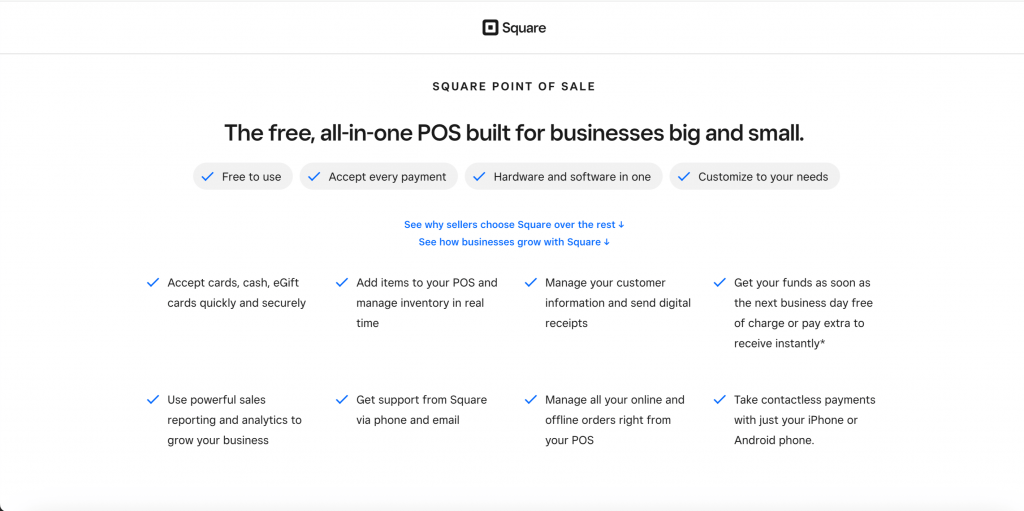
Square is the most accessible POS on this list. Most of its core features are completely free for all users, and with just a phone and a $49 card reader, you’ll be ready to start accepting payments as it connects to QuickBooks Online through Intuit’s native Sync with Square app at no additional charge.
QuickBooks integration: Native, via the free Connect to Square app for QuickBooks Online. On QuickBooks Desktop, Commerce Sync is required ($10/month per location). The integration syncs sales, expenses, refunds, and tips into QuickBooks automatically.
For businesses that need more granular data, like individual transaction records with product-level detail, fee breakdowns, customer info, and automatic reconciliation, Synder supports Square-to-QuickBooks sync with per-transaction or summary options, including COGS tracking and automation rules for custom categorization.
Core features:
- Inventory management
- Free online appointment scheduler for salons, spas, and other appointment-based businesses
- Industry-specific tools for retail and restaurants
- No long-term contracts (month-to-month billing)
Pricing:
| Plan | Price/month | What’s included |
| Free | $0 | Full POS app, basic inventory management, unlimited items, ecommerce website, email, and chat support. In-person processing: 2.6% + 15¢. Online: 3.3% + 30¢. |
| Plus | $49/location | Everything in Free, plus advanced retail reports, inventory management, vendor and purchase order management, shift management, team management, and product exchanges. In-person: 2.5% + 15¢. Online: 2.9% + 30¢. |
| Premium | $149/location | Everything in Plus, plus cross-location fulfillment, seat and reservation management, vendor sales reporting, 24/7 phone support. In-person: 2.4% + 15¢. Online: 2.9% + 30¢. |
Square overhauled its pricing in October 2025, consolidating all business types (retail, restaurant, and appointments) into three unified tiers.
Ideal for: Solopreneurs and small business owners who want a low-commitment way to take sales on the go, set up an affordable in-store register, or get an online store running quickly.
Watch out for: As transaction volume grows, flat-rate processing fees add up faster than interchange-plus models from dedicated merchant service providers.
Shopify POS
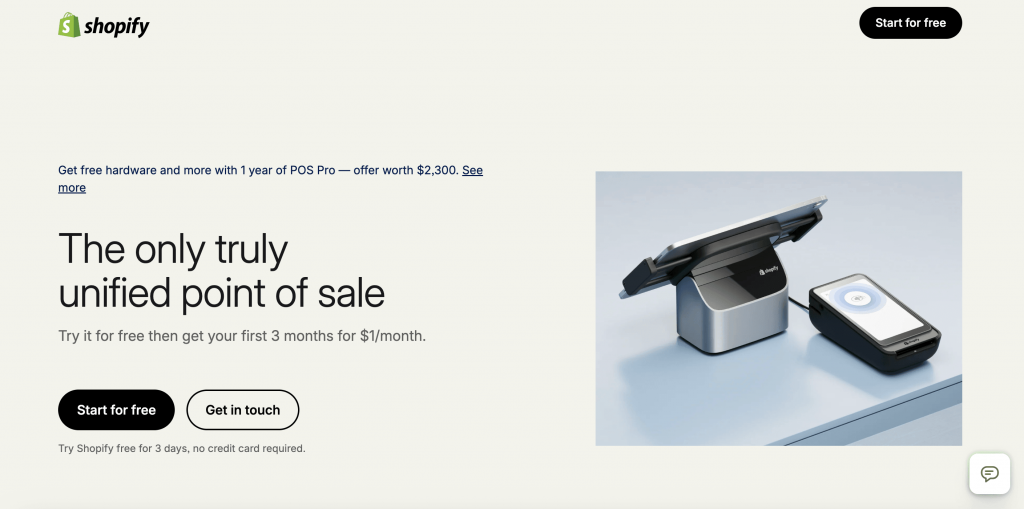
Shopify holds a formal partnership with Intuit for the QuickBooks transition, making it the recommended replacement for former QuickBooks POS Desktop users who also sell online. Its strength is unified commerce: one system for your online store, in-store sales, social selling, and marketplaces.
QuickBooks integration: Shopify connects to QuickBooks Online through several apps in the QuickBooks App Marketplace, including ones that sync daily sales summaries or individual transactions.
Synder also supports Shopify-to-QuickBooks sync with detailed line-level data, useful for businesses that need detailed sales reporting or COGS tracking.
Core features:
- Omnichannel selling (buy online, pick up in-store, local delivery, or shipping; ship in-store purchases to customers)
- Customer profiles
- Inventory sync across locations
- Buy online, pick up in-store (BOPIS)
- Loyalty tools
Pricing:
| Plan | Price/month | What’s included |
| Basic (with POS Lite) | $29 | Casual in-person selling features: take payments, basic customer info, limited returns/exchanges. POS Lite is included with all paid Shopify plans. |
| POS Pro add-on | +$89/location (or $67/location billed annually) | Full retail POS features: unlimited staff accounts, advanced inventory management, buy online/pick up in-store, detailed sales reporting, staff permissions. Required for serious brick-and-mortar operations. |
Shopify POS pricing consists of two parts: a base Shopify plan (starting at $29/month) plus the POS Pro add-on ($89/location/month) for advanced retail features. POS Lite is included free with all paid plans.
Ideal for: Retailers with an existing Shopify online store, or businesses building out an ecommerce presence alongside physical retail. If you use Shopify’s mobile card reader, you can sell on social media and marketplaces such as Amazon and Etsy, and on the go.
Watch out for: Shopify’s primary focus is ecommerce. Brick-and-mortar-only businesses may find they’re paying for ecommerce infrastructure they don’t use.
3. Lightspeed

Lightspeed is the other integration Intuit officially recommended for QuickBooks Online users post-discontinuation. It’s built for businesses with complex inventory needs: multiple locations, rental management, and high-SKU environments.
QuickBooks integration: Lightspeed connects to QuickBooks Online through its Accounting add-on. Without this add-on, data export to QuickBooks is manual. With it, sales, inventory, tips, invoices, and customer data sync automatically. The integration automates data entry and supports daily POS reconciliation.
Core features:
- Advanced inventory management
- Multi-location support on all plans (including temporary or seasonal stores)
- Third-party integrations for scheduling and reservations
- Dedicated golf course POS
Pricing:
| Plan | Price/month | What’s included |
| Basic | $89 | Retail POS software, inventory tracking, supplier catalog access, basic built-in ecommerce, 24/7 chat support, onboarding services. |
| Core | $149 | Everything in Basic, plus in-store and online loyalty programs, advanced sales/staff/inventory reports, accounting and marketing integrations, mobile scanner app. |
| Plus | $289 | Everything in Core, plus custom reporting, integrated forecasting, API access, workflows, custom user roles, 24/7 phone support. |
Prices reflect annual billing with Lightspeed Payments. Monthly billing and third-party payment processors are available at higher rates. Pricing may vary by location count and business type.
Ideal for: Mid-sized retailers, multi-location businesses, rental operations, and any business where real-time inventory accuracy is a priority.
Watch out for: The QuickBooks sync requires the Accounting add-on, which adds to the monthly cost. Factor that in before comparing sticker prices.
4. Clover
Clover provides a dedicated merchant account with custom payment processing fees, and it’s a meaningful advantage for businesses with larger sales volumes or smaller average ticket sizes that can negotiate better rates. Its app market is extensive, and the hardware lineup covers everything from countertop terminals to handheld devices.
QuickBooks integration: Clover integrates with QuickBooks Online through Commerce Sync, which syncs Clover sales data into QuickBooks automatically. The Connect to QuickBooks app on Clover’s app marketplace is another option.
If Commerce Sync’s summary-level posting isn’t giving you enough visibility into what’s getting into your books, Synder is worth looking at. It pulls Clover transaction data into QuickBooks with the line-level detail that makes month-end reconciliation faster and easier to audit.
Core features:
- Customizable merchant account
- Built-in loyalty program
- Online ordering
- Large app marketplace
- Hardware for retail and restaurant use
Pricing:
| Plan | Price/month | What’s included |
| Starter | From ~$14.95 | Basic payments and sales tracking for service businesses. |
| Standard | From ~$44.95 | Adds inventory management, employee management, and more reporting. |
| Advanced | From ~$54.90 | Full feature set including loyalty, online ordering, and advanced reporting. |
Clover pricing varies a lot by reseller, hardware bundle, and contract length. The figures above reflect Clover’s published software subscription fees; hardware costs are separate and negotiated with your reseller. Always confirm final pricing, including processing rates and contract terms, directly with the reseller before signing.
Ideal for: High-volume businesses that want negotiated payment processing rates and a highly customizable POS setup.
Watch out for: Clover offers both 36-month and 48-month contract options with early termination fees. Unless a fee waiver is written into your merchant agreement, verbal promises from sales reps won’t hold up. Look for a Clover reseller with month-to-month contracts and flat-rate or interchange-plus payment processing fee structures.
Toast
Toast is purpose-built for restaurants and food service businesses. It covers the full operational stack: POS, scheduling, payroll, inventory, loyalty, and its proprietary Android-based hardware is the most durable in the restaurant industry, with countertop and mobile devices built to withstand drops and spills.
QuickBooks integration: Toast integrates with QuickBooks Online through xtraCHEF, a subscription add-on. This syncs sales, COGS, and labor data into QuickBooks, with reporting visibility into food cost percentages and margin by category.
Core features:
- Online, tableside, self-order, and kiosk ordering options
- Highly customizable kitchen display workflows
- Payroll management
- Advanced inventory and recipe costing
Pricing:
| Plan | Price/month | What’s included |
| Starter Kit | $0 (pay-as-you-go) | Core POS software, in-person ordering, menu management, basic reporting, 24/7 support. Higher processing rate: 3.09% + 15¢. Hardware costs covered via higher processing fees. Subject to 2-year agreement. |
| Point of Sale | $69 | Everything in Starter, plus scheduling tools, team management, more advanced reporting. Processing: 2.49% + 15¢. Hardware purchased upfront. |
| Build Your Own | Custom | Modular pricing for multi-location or high-volume restaurants. Add payroll, marketing, loyalty, catering tools individually. |
Toast hardware is proprietary and only works with Toast software. Hardware costs $500–$1,000+ per terminal and must be purchased upfront or financed. Most Toast agreements are 1–3 years with early termination fees.
Ideal for: Mid-sized to large restaurants and multi-location food service operations that need a complete management platform, not just a payment terminal.
Watch out for: Toast has moved toward long-term contracts of up to three years with significant termination fees. Negotiate a shorter contract or request a trial period before committing.
6. Revel Systems
Revel is a self-contained POS ecosystem with solutions for retail, restaurants, and service businesses, and you can combine features across industries, which makes it well suited to hybrid operations that sell both retail items and made-to-order food or services.
QuickBooks integration: Revel is officially partnered with QuickBooks, meaning the integration is streamlined and doesn’t depend on a third-party connector. It syncs sales, inventory, and customer data into QuickBooks automatically.
Core features:
- Multi-industry support
- Integrations with drive-through communications, security services, digital signage boards, and guest feedback platforms
- Open API access
- CRM functionality
Pricing:
| Plan | Price/month | What’s included |
| Custom | Quote-based (starting ~$99) | Full POS platform including inventory, CRM, reporting, open API, and multi-industry support. Price varies by number of terminals, locations, and features selected. |
Revel doesn’t publish standard plan tiers. Pricing is quote-based and negotiated directly. Its lowest pricing requires a three-year contract commitment. Month-to-month is available at a higher price – avoid locking in long-term until you’ve confirmed the system fits your operation.
Ideal for: Large, multi-location, or operationally complex businesses, including those that combine retail, food service, and service operations in a single location.
Watch out for: Revel is not a budget option. The pricing reflects the depth of the platform, but smaller businesses may find they’re paying for capabilities they don’t need.
POS systems for QuickBooks: pros and cons
| POS system | Pros | Cons |
| Square | Free native QuickBooks connector – no extra subscription needed. No contracts, cancel anytime. Quick to set up with minimal technical overhead. | Flat-rate processing gets expensive at higher volumes. Inventory and reporting depth is limited compared to dedicated retail platforms. |
| Shopify POS | Strongest omnichannel story – online and in-store inventory unified from day one. Large app ecosystem for extending functionality. | POS Pro is a required add-on for serious retail use, adding $89/location on top of your base plan. Ecommerce-first design can feel excessive for pure brick-and-mortar. |
| Lightspeed | Deep inventory management purpose-built for retail – product variants, purchase orders, supplier catalogs. Multi-location support on every plan. | QuickBooks sync requires a paid Accounting add-on; without it, data export is manual. Premium pricing relative to other options on this list. |
| Clover | Negotiable processing rates through resellers – valuable for high-volume businesses. Wide hardware and app market flexibility. | Contract terms vary wildly by reseller and are difficult to exit early. Integration quality depends on which connector you use and how it’s configured. |
| Toast | Restaurant-specific depth that generalist POS systems can’t match – kitchen workflows, coursing, table management. Durable proprietary hardware. | Locked into Toast Payments – no third-party processors. Proprietary hardware means high switching costs if you leave the platform. |
| Revel | Native QuickBooks partnership streamlines setup. One of the few platforms that genuinely supports hybrid retail-and-food operations under a single system. | Pricing requires a quote and favors businesses that commit to multi-year contracts. Too complex and costly for single-location or simple retail operations. |
How to set up a POS and QuickBooks integration
The setup process is largely the same across POS systems. Here’s what it looks like in practice, based on integrations for QuickBooks Online.
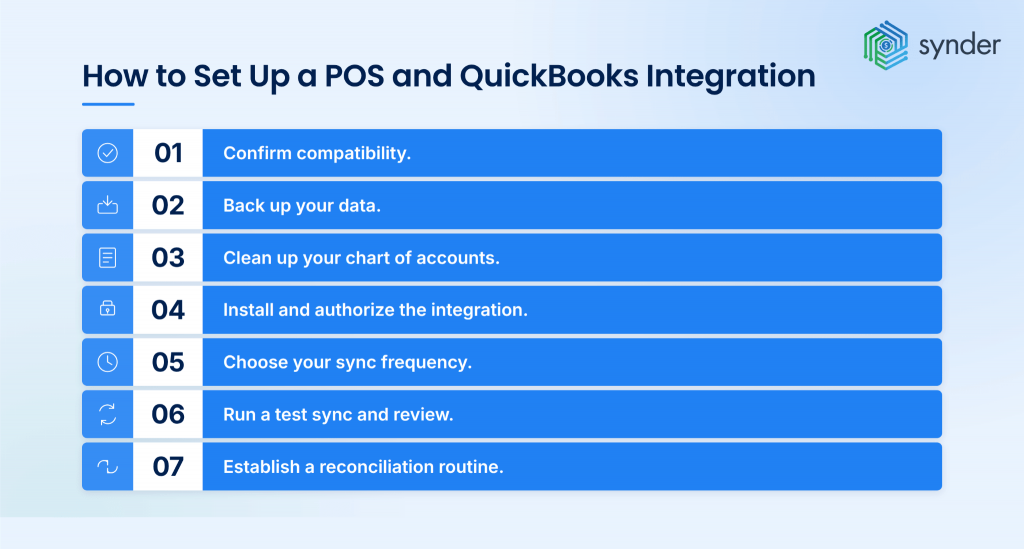
Step 1: Confirm compatibility. Identify which QuickBooks product you use: Desktop, Online, or the legacy QuickBooks Point of Sale, and make sure your chosen POS supports that setup. Compatibility matters for features like inventory sync and how sales summaries post.
Step 2: Back up your data. Before making any changes, create a fresh backup of your QuickBooks company file and your POS database. This gives you a clean rollback point if anything doesn’t sync as expected. It’s also a good moment to tidy item names, categories, and tax settings so they’re consistent across both systems.
Step 3: Clean up your chart of accounts. Make sure account names, tax settings, and item categories are consistent between your POS and QuickBooks. Mismatched names are a common source of reconciliation headaches.
Step 4: Install and authorize the integration. Download or activate the connector app either from the QuickBooks App Marketplace or your POS provider’s integration settings. Authorize the connection when prompted and configure the key settings: map sales accounts, taxes, discounts, and payment methods. Choose whether customers and inventory sync, and decide on posting frequency: daily summaries, shift-based batches, or near real time.
Step 5: Choose your sync frequency. The POS sends sales data into QuickBooks depending on your settings. Options typically include daily summary, or shift-based batches at the end of each day or shift, or continuous sync of individual transactions. For most small retail businesses, a daily summary that posts one entry per payment method per day is the cleanest approach, which is easy to reconcile and easy to spot errors.
Step 6: Run a test sync and review. After the first sync, pull a report from your POS for the same period and compare totals against what landed in QuickBooks. Review imported entries, reconcile deposits against merchant payouts, and monitor inventory adjustments so on-hand quantities stay accurate.
Step 7: Establish a reconciliation routine. On a weekly or monthly cadence, match your QuickBooks clearing account balance against your bank statement and processor payout reports. This is the only way to confirm the integration is working accurately over time.
The most common issues: mismatched totals usually come from taxes or payment tenders mapped to the wrong accounts; duplicate entries typically mean a batch was imported twice; and date or time zone misalignments can cause reports to fall out of sync across systems. All three are fixable at the settings level.
What to look for when choosing a POS system for QuickBooks
The right choice depends on your business more than any feature checklist. That said, a few factors tend to matter most.
- Integration depth. How much detail actually comes through? Some systems sync every transaction, others just daily summaries. The more granular it is (fees, items, taxes), the less cleanup you’ll deal with later in QuickBooks.
- Inventory tracking. If you sell products, this matters a lot. When your POS keeps quantities and costs in sync with QuickBooks on every sale, your COGS and margins stay accurate without extra work.
- Multi-channel support. Selling both in-store and online? You’ll want one system that handles both. Otherwise, you’re merging two separate data streams before they even hit your books.
- Sync frequency. Real-time sync keeps your numbers fresh but needs precise setup. Daily or shift-based sync is simpler and often easier to reconcile if you have a lot of transactions.
- Contract terms. Monthly plans give you flexibility while you test things out. Longer contracts usually cost less but lock you in, which can be risky if the setup doesn’t fit your workflow.
- What happens when something breaks. It will happen at some point. The real question is how fast you can fix it. Before choosing a POS, check reviews on integration reliability and how responsive their support actually is.
When your POS-to-QuickBooks sync isn’t enough
Getting data into QuickBooks is one part of the problem. Getting it to reconcile accurately, meaning your QuickBooks balance matches your bank statement and your processor payouts, is where many businesses run into ongoing friction.
The core issue is that a POS integration alone doesn’t account for the full money flow. A sale of $100 on Shopify, for example, doesn’t land as $100 in your bank. It lands as a net payout after Shopify’s processing fee, sometimes days later, pooled with other transactions in a single deposit. Your books need to reflect all of that accurately: the gross sale, the fee, and the net deposit that matches what actually arrived in your account.
For businesses processing sales across multiple channels, like a physical POS, an online store, and a marketplace like Amazon, it quickly gets difficult. Each platform has its own payout timing, fee structure, and reporting format. When the feeds flow into QuickBooks separately, reconciling month-end means cross-referencing multiple data sources.
One way that works well for multichannel sellers is using an accounting automation layer alongside the POS integration. Tools like Synder, for example, can pull transaction data from 30+ platforms, including Shopify, Square, Stripe, and PayPal, and sync it to QuickBooks in either per-transaction or batch entries format. Each entry includes gross sales, fees, taxes, and refunds, structured so they reconcile against bank deposits automatically.
With this kind of automation, ecommerce businesses can save 2–3 hours per week on manual entry and reclaim 12–18 full workdays per year on QuickBooks management.
Synder helped us automate what was previously a very manual process. Instead of having to manually duplicate information between Shopify and QuickBooks, we can now focus on adding products to one system and let Synder handle the rest.
Cassandra Tiltack, Head of Customer Operations, SleepEh
If you want to see how this works in practice for a multichannel setup, you can book a demo with Synder.
| That said, if you’re running a single-location retail business with one payment method and clean daily settlement, a native POS integration is usually all you need. The added layer makes more sense when the complexity that comes with multiple platforms, high transaction volumes, or multi-currency makes the native sync insufficient on its own. |
Conclusions on QuickBooks POS systems
QuickBooks Desktop POS is gone, but the core need it served – a connected system where sales data flows into accounting automatically – is better served today than it was in 2023. Modern POS systems like Square, Shopify POS, Lightspeed, Clover, Toast, and Revel all integrate with QuickBooks Online, most through native apps or low-cost connectors.
The integration itself is manageable, but the harder question is which POS fits your business type, transaction volume, and channel mix. For simple single-location retail, Square’s free plan and native QuickBooks sync is hard to beat. For ecommerce-first businesses, Shopify POS consolidates the most under one roof. For complex, multi-location, or hybrid operations, Revel and Lightspeed carry the depth that smaller systems can’t match.
Whatever you choose, the integration is only as reliable as the account mapping behind it. Take the time to configure it correctly at setup, run a test reconciliation before going live, and build a routine for checking it monthly, which will keep your books accurate.
FAQ
Does QuickBooks offer a POS system?
Intuit officially retired its QuickBooks Desktop POS software on October 3, 2023. QuickBooks no longer has a native point-of-sale product, but QuickBooks Online integrates with dozens of third-party POS systems through the QuickBooks App Marketplace, including Square, Shopify, Lightspeed, and Clover.
What are people replacing QuickBooks POS with?
The most common replacements are Square (for small businesses), Shopify POS (for ecommerce-first retailers), Lightspeed (for inventory-heavy retailers), and Clover (for businesses wanting custom payment processing). Intuit itself recommended Shopify for QuickBooks Desktop users and Lightspeed for QuickBooks Online users as transition options.
Do I have to use QuickBooks accounting software if I want a QuickBooks POS integration?
You do need QuickBooks to use a QuickBooks POS integration, but you’re choosing among the POS systems that connect to QuickBooks, not a QuickBooks-branded POS. Any POS system with a native or third-party QuickBooks integration will sync your sales data into your existing QuickBooks Online or Desktop account.
Is QuickBooks Desktop going away in 2026?
QuickBooks Desktop POS has been discontinued. QuickBooks Desktop is still supported, but QuickBooks Online has become the standard for businesses that need integrations, including POS connections. Most POS systems integrate with QuickBooks Online, while some still support Desktop through third-party connectors like Commerce Sync. If you’re still using QuickBooks Desktop POS, it’s worth planning a move to a modern POS that works well with QuickBooks Online, and if you’re staying on Desktop for now, double-check compatibility before choosing a system.




Excellent article! I will check out QuickBooks for my own personal tax advisory UK business.
Thanks David, we’re happy to help!