
.png)
Sales tax tends to get more demanding as soon as your business starts expanding. Selling in multiple states, adding new marketplaces, or increasing order volume brings more rules, more reporting, and more deadlines to track. At that stage, even well-organized teams often find that manual processes struggle to keep pace with daily sales activity.
This guide is meant to help you explain these complexities with clarity. It looks at how modern sales tax tools support ecommerce businesses, what features actually matter in practice, and how leading solutions compare when you’re deciding which option aligns with your workflows and growth plans.
TL;DR
- Sales tax automation helps you keep rates accurate, track obligations across states, and reduce filing pressure as your ecommerce business grows.
- The right software depends on your real workflow, not just features: some tools focus on filings, others on compliance depth, geographic coverage, or managed services.
- Implementation matters as much as the tool itself, so reliable integrations with ecommerce platforms and accounting systems are key to getting consistent results.
What is sales tax automation software?
At a practical level, sales tax automation software sits between your sales platforms and your accounting system and keeps tax logic consistent as transactions flow through. It applies the right tax rules at the moment a sale happens, tracks where tax obligations arise, and keeps records aligned with what is reported and filed later. If you’ve ever asked yourself whether the numbers in your store, payment processor, and books truly line up, this is the layer that keeps them in sync.
For ecommerce teams, the value shows up in everyday operations rather than theory. Orders move fast, refunds happen, fees get deducted, and sales cross state lines without warning. Sales tax automation software is built to handle those realities without forcing you to slow down or manually intervene at every step.
Key features of sales tax automation software
When evaluating sales tax software, the real test is how it behaves in everyday situations, not in a demo. The features below are the ones that tend to show their value once the software is handling live transactions and real financial data.
- Integration with ecommerce and accounting systems. Sales tax data only stays reliable when it flows cleanly between your store, payment processors, and accounting software. Strong integrations help prevent mismatches that often appear during reconciliation.
- Accurate tax calculation at the point of sale. The software applies current tax rates and rules based on customer location and product type as sales happen. This feature reduces discrepancies between what customers are charged and what ends up recorded in your accounting system.
- Nexus tracking across states. As sales volumes increase, it becomes harder to keep track of where tax obligations begin. Accounting automation tools monitor thresholds and activity by state so you know where compliance applies without constant manual reviews.
- Centralized tax reporting. Instead of pulling data from multiple platforms, the software consolidates tax data into clear reports. Thus, it’s easier to review collected amounts, spot inconsistencies, and prepare for filings.
- Handling refunds and adjustments. Returns, partial refunds, and order changes affect tax totals. Automation tools account for these changes, so reported tax figures reflect what actually happened, not just the original sale.
Top sales tax automation software
Here are a few of the most widely used sales tax automation tools, each designed to support different sales setups and accounting workflows. The sections below outline how they typically fit into real ecommerce operations and where each one tends to work best.
1. Synder
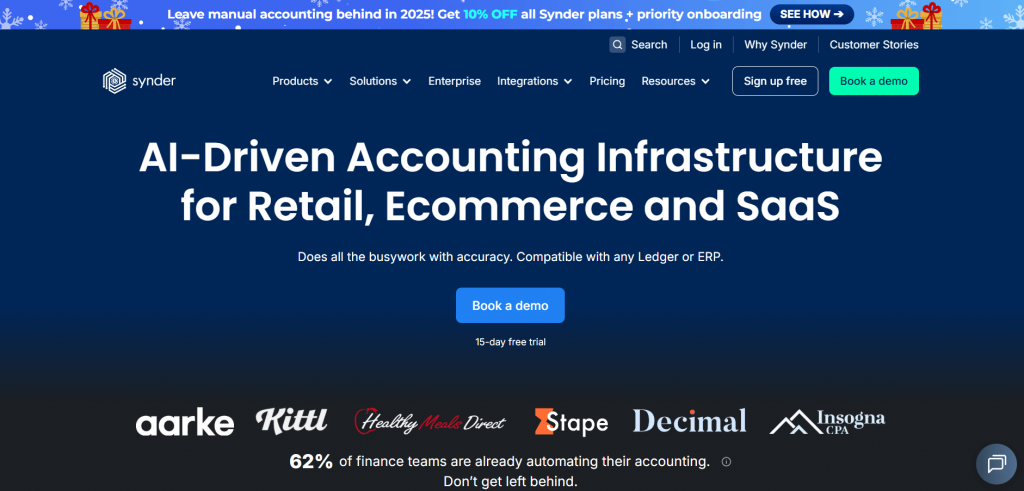
Synder approaches sales tax from an accounting-first perspective. It’s built for situations where tax accuracy depends on how cleanly sales data flows from platforms like Shopify, Amazon, Stripe, PayPal, Square, TikTok Shop, and WooCommerce into accounting systems and ERP such as QuickBooks Online, Xero, Sage Intacct, NetSuite, and Puzzle. Instead of isolating tax as a separate process, Synder keeps tax amounts tied directly to the transactions that created them, which makes reviews, reconciliation, and reporting far more predictable when using per-transaction sync.
Key features
- Sales-platform tax captured and correctly mapped to accounting systems
- Consistent tax treatment across sales, refunds, and platform fees
- Configurable Smart Rules to control how tax data is recorded in accounting
- Flexible posting options with per-transaction or summarized records
- Tax adjustments reflected automatically when orders change
- Support for multiple tax types, including sales tax, VAT, and GST
- Coverage for both US and non-US taxes, including Canada, the UK, and other regions
Pricing
| Pricing plan | Price (billed annually) | Features |
| Basic | $52/month | Supports up to 500 transactions, includes two connected platforms, daily syncs, and core inventory and multi-currency functionality. |
| Essential | From $92/month | Covers 500 to 3,000 transactions, allows unlimited integrations, increases sync frequency to hourly, and expands inventory tracking. |
| Pro | From $220/month | Supports up to 50,000 transactions with advanced product mapping, bundle and assembly syncing, and guided onboarding. |
| Premium | Custom pricing | Offers multi-entity structures with tailored onboarding and priority-level support. |
When to choose Synder
Synder is a good fit for ecommerce and SaaS businesses selling across multiple channels that need tax data to remain consistent from checkout to reconciliation and financial reporting. Its advantage lies in being an all-in-one solution, combining solid tax handling with payment syncing, inventory tracking, and automated accounting workflows in a single platform.
Considering an upgrade to your current sales tax process? Start a free Synder account or book a demo to see how accurate tax data, cleaner books, and multi-channel automation work.
2. Avalara
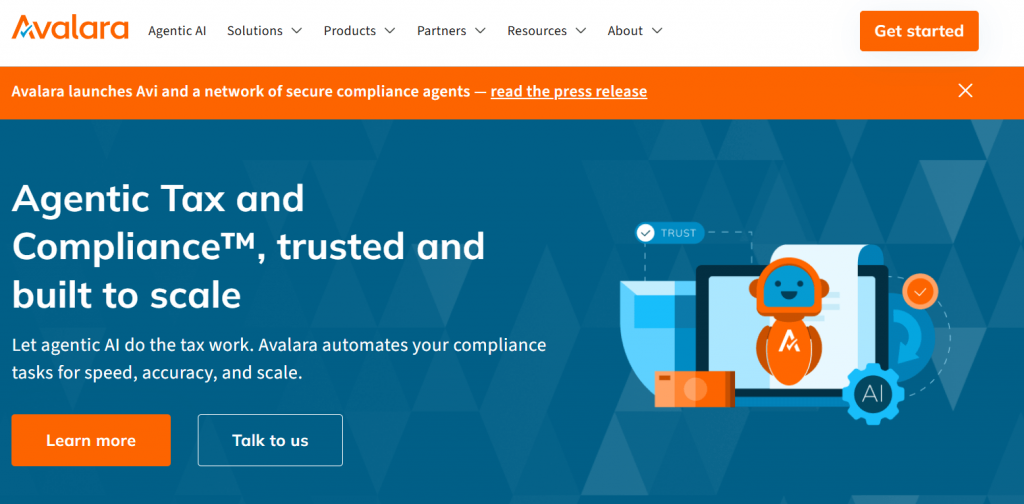
Avalara is built for businesses that treat sales tax compliance as a dedicated operational function. It focuses heavily on tax calculation accuracy, jurisdiction coverage, and filing workflows, which makes it a common choice for companies operating across many states with complex tax exposure. Avalara typically sits alongside ecommerce platforms and ERP systems, acting as a centralized tax engine, not an accounting layer.
Key features
- Real-time sales tax calculation based on location and product taxability
- Broad coverage of state and local tax jurisdictions
- Automated sales tax return preparation and filing in supported regions
- Exemption certificate collection and management
- Nexus tracking tools to monitor compliance thresholds
- Integrations with major ecommerce platforms, ERPs, and marketplaces
Pricing
| Pricing plan | Price | Features |
| AvaTax tax calculation | Custom pricing (quote required) | Real-time sales tax calculation and jurisdiction coverage. Cost depends on transaction volume and regions where tax is collected. |
| Sales tax returns & reporting | Custom pricing (quote required) | Preparation of sales tax returns and reporting for multiple jurisdictions. Pricing varies with the number of returns and locations. |
| Business license guidance | From $99 per license | Assistance in identifying and obtaining necessary business tax licenses. |
| Sales tax registration | $403 per location | State and local tax account registration assistance. |
When to choose Avalara
Avalara is often a good option for businesses with high transaction volumes, wide geographic reach, or strict compliance requirements. It tends to work best when tax calculation and filing need to be handled at scale, even if accounting and reconciliation are managed separately in another system.
3. TaxJar
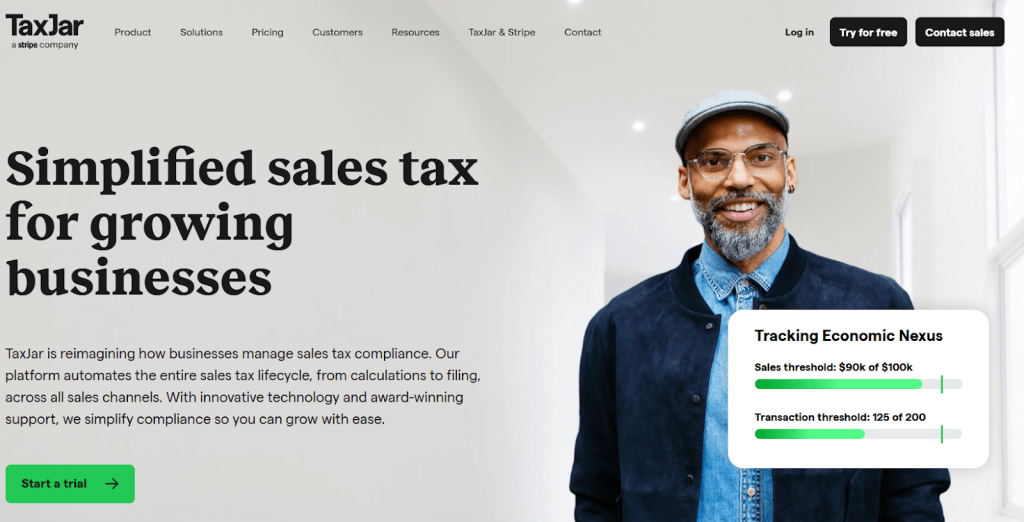
TaxJar is a sales tax automation tool designed with ecommerce sellers in mind. It focuses on making tax calculation, reporting, and filing more straightforward for businesses that sell through multiple storefronts and marketplaces. TaxJar is designed specifically for small and medium-sized businesses based in the US.
Key features
- Automated sales tax calculation for online orders based on location and product profile
- Consolidated reporting across multiple sales channels and marketplaces
- Sales tax filing support with prepopulated returns in many states
- Nexus tracking and alerting to help identify new compliance obligations
- Marketplace seller support with imported transaction data from platforms like Amazon and Etsy
Pricing
| Pricing plan | Price | Features |
| Starter plan (reports) | From $19/month (based on order volume) | Basic sales tax reporting and filings support. Supports up to 3 data import integrations and includes 4 AutoFile credits per year. |
| Professional plan (reports + API) | From $99/month (based on order volume) | Enhanced reporting, real-time calculations via API, up to 10 integrations, and 12 AutoFile credits per year. |
When to choose TaxJar
TaxJar makes sense when your focus is accurate sales tax figures and streamlined filing without handling the other accounting tasks. It tends to work well for ecommerce sellers who use several marketplaces and want reliable tax reporting without managing too many separate tools.
4. Sovos
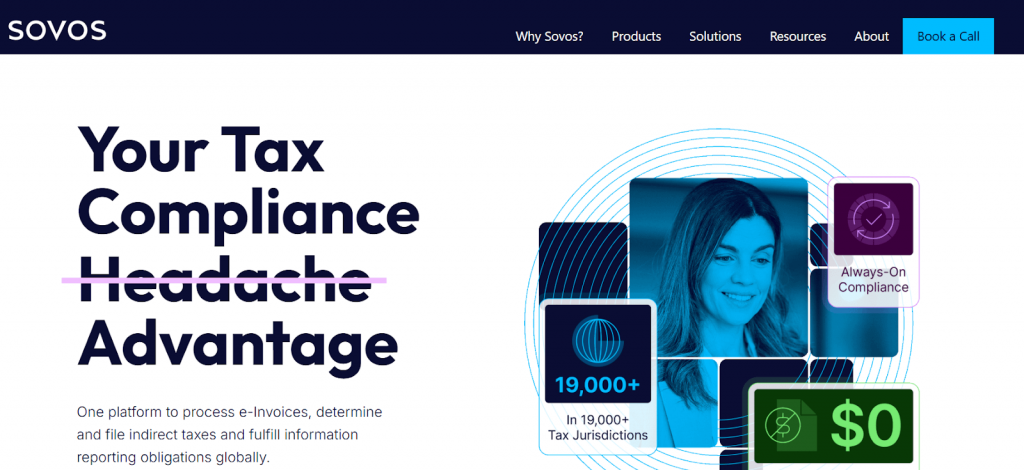
Sovos focuses on handling the operational side of sales tax compliance with a strong emphasis on accuracy, documentation, and regulatory consistency. It works as a centralized system for managing tax calculation, filings, reporting, and record keeping, helping teams maintain reliable compliance processes even as tax obligations span multiple regions and regulations.
Key features
- Real-time tax calculation using up-to-date rate and rule databases
- Automated tax return preparation and filing across supported regions
- Nexus monitoring to help identify where filings are required
- Exemption certificate management and storage tools
- Comprehensive audit trail and compliance documentation
- Integration with ERP systems and large-scale ecommerce platforms
Pricing
Sovos doesn’t disclose fixed pricing publicly. Costs are typically quote-based, with modular products and fees that vary depending on use case, business size, transaction complexity, number of jurisdictions, and overall compliance scope.
When to choose Sovos
Sovos is a strong fit when your business has significant tax complexity, such as many filing jurisdictions, frequent rate changes, or extensive exemption management needs. It works well for larger ecommerce operations and organizations looking for a single vendor to support calculation, filing, and compliance documentation.
5. Vertex

Vertex provides sales tax automation with a strong foundation in tax calculation logic and location intelligence. It emphasizes current rate and rule accuracy tied to geographic boundaries, helping ensure that transactions reflect the correct tax requirements based on where goods are delivered and services are rendered.
Key features
- Real-time tax calculation using detailed geographic tax and rule datasets
- Automated tax determination for physical goods and certain service categories
- Integration connectors for ecommerce carts, ERPs, and order systems
- Nexus tracking and monitoring tools for multiple regions
- Comprehensive documentation and audit reports for compliance review
Pricing
Vertex doesn’t publish pricing on its website. Costs are determined on a case-by-case basis and typically depend on business scale, team size, implementation scope, and the specific modules or managed services included.
When to choose Vertex
Choose Vertex when tax calculation precision and geographic rule coverage are priorities in your ecommerce workflows. It works well for organizations that need accurate tax amounts across diverse sales regions.
6. TaxValet
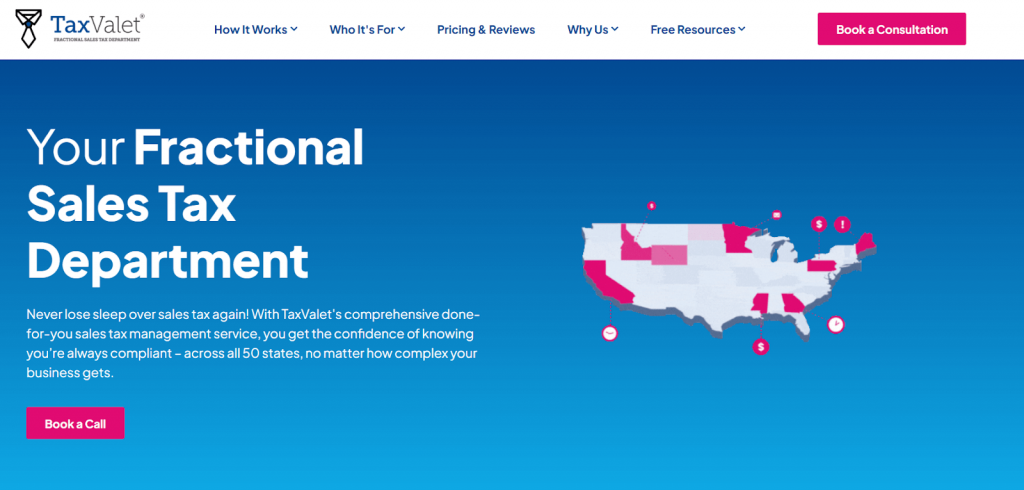
TaxValet focuses on removing day-to-day sales tax management tasks from internal teams by handling compliance processes on an ongoing basis. It doesn’t operate only as software, as it combines technology with managed service support to help businesses keep filings, registrations, and reporting consistently maintained without constant internal oversight.
Key features
- End-to-end sales tax filing management handled by TaxValet’s team
- Registration assistance for states where tax obligations apply
- Centralized tax reporting with clear visibility into filing status
- Nexus monitoring to identify new compliance requirements
- Support for marketplace and multichannel sellers
- Tools and workflows built specifically around ongoing compliance operations
Pricing
| Pricing plan | Price | Features |
| All-in-one managed compliance services | $1,000–$3,000/month | Ongoing filing management, registration support, monitoring, and dedicated compliance operations based on the number of states and filing complexity. |
When to choose TaxValet
TaxValet is worth considering if you prefer to outsource much of the operational tax burden while still having visibility into what’s happening. It suits businesses that want reliable compliance execution supported by a dedicated team rather than managing filings entirely through internal staff or software alone.
7. CereTax
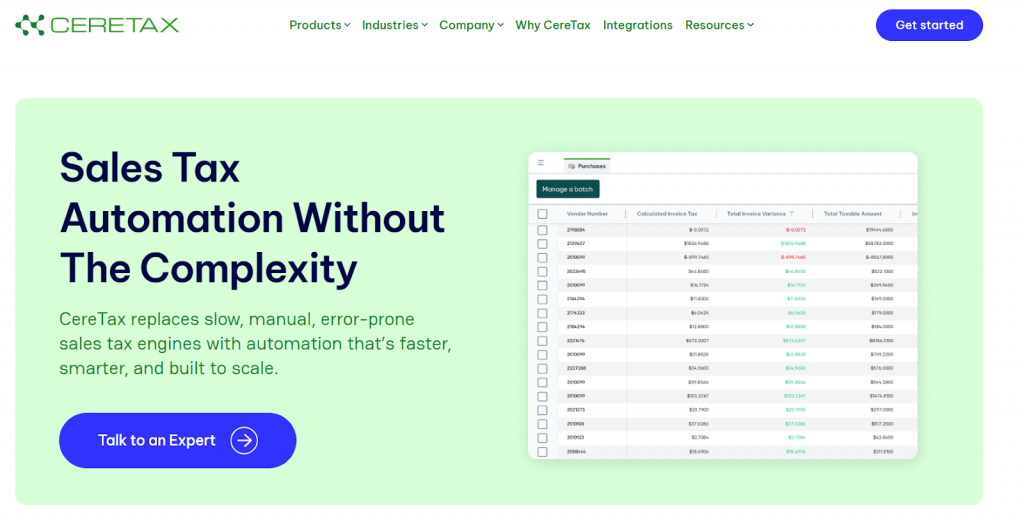
CereTax is designed to handle complex sales tax calculations in a way that stays clear and understandable. The platform shows how rates, rules, exemptions, and locations affect each transaction, giving you visibility into how every tax amount is determined. It integrates with ecommerce platforms, billing systems, and ERPs, so tax treatment remains consistent across everyday operations.
Key features
- Immediate sales and use tax calculation with precise location-based accuracy
- Configurable rule engine that adapts as products and jurisdictions change
- Transparent view of how tax decisions are applied to each transaction
- Integrations with ecommerce platforms, billing systems, and ERPs
- Tools for managing exemptions and special tax categories
- Audit-ready reports with a clear explanation of tax outcomes
Pricing
CereTax doesn’t offer standardized, publicly listed pricing. Final cost is shaped through a consultation process and depends on factors such as transaction scale, integration complexity, geographic coverage, and specific compliance needs.
When to choose CereTax
CereTax is a solid option when you want reliable tax calculation along with visibility into how results are produced. It suits teams that value clarity, strong reporting, and traceable compliance processes.
8. Kintsugi
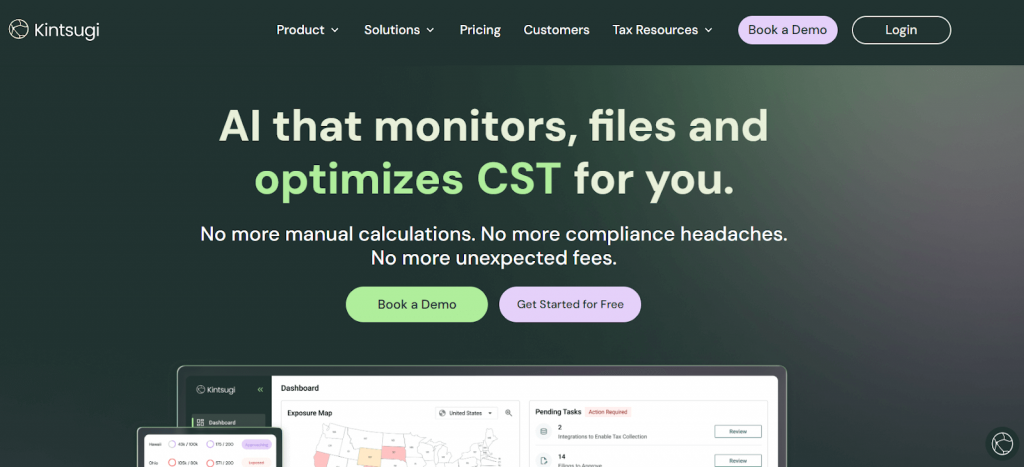
The word kintsugi comes from Japanese art, referring to the practice of repairing broken pottery with gold to highlight and celebrate its history. And in the world of sales tax compliance, Kintsugi aims to bring that same clarity to tax processes by making tax calculation, nexus tracking, registration, and filing easier to understand and manage.
Key features
- Real-time sales tax, VAT, and GST calculation across jurisdictions with precise rule logic
- Automated nexus monitoring and alerting for new compliance obligations
- Integrated tools for registration and sales tax filing across supported regions
- Centralized reporting that shows tax liabilities and filing status
- Support for multiple sales channels, platforms, and custom stacks
- APIs and SDKs for seamless integration into existing workflows
Pricing
| Pricing plan | Price | Features |
| Free | $0 | Includes nexus monitoring, exposure and liability auditing, automated risk assessment, nexus alerts, address validation, easy CSV imports, and no-code integrations. |
| Starter | Starting at $75 per filing or registration | Includes everything in Free plus faster data sync, automated filings and registrations, deregistrations, tax code classification, virtual mailbox, refunds and amendments, exemption certificate management, and live chat support. |
| Premium | Custom | Includes all Starter features with a fixed price, volume-based discounts, API and premium connectors, filing autopilot, voluntary disclosure agreements, multi-country support, error insurance, single sign-on, and advanced reporting with premium support. |
When to choose Kintsugi
Choose Kintsugi when you want unified sales tax automation that combines calculation, monitoring, registration, and filing in a single system. It’s a good match for teams selling across multiple regions who want better visibility into how tax obligations evolve.
9. LOVAT
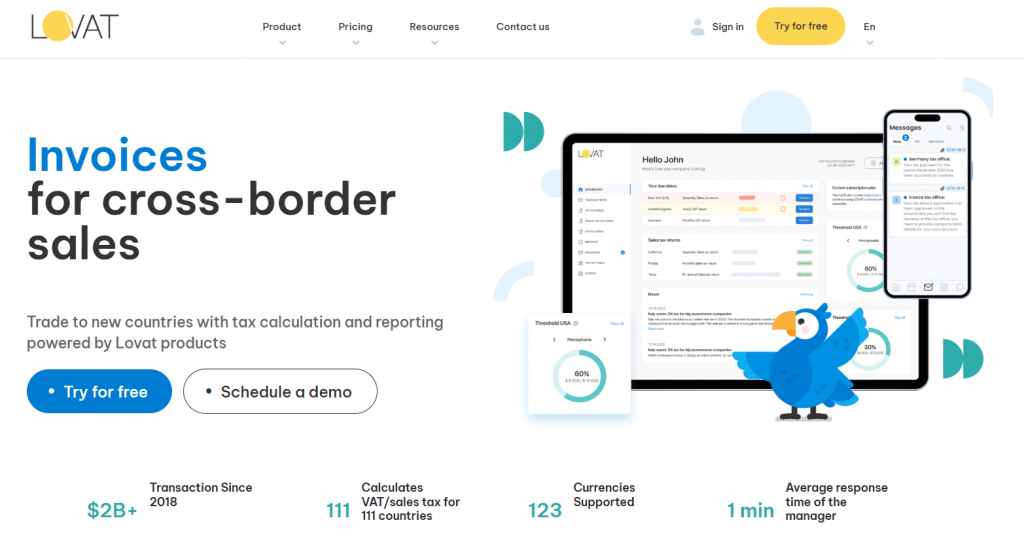
LOVAT is a tax compliance platform built to help businesses handle VAT, sales tax, and related reporting across many countries from a single system. It calculates tax amounts based on locations and rules, tracks registration and filing deadlines, and helps you prepare and submit returns for both VAT and sales tax without juggling separate tools across regions.
Key features
- Real-time tax calculation for VAT, sales tax, and GST in more than 111 countries
- Threshold tracking and alerts to know when tax registration is required
- Online registration support for VAT and tax numbers
- Auto submission tools for tax returns and compliance filings
- Centralized reporting with visibility into liabilities and deadlines
- Integrations with ecommerce platforms and marketplaces for data flow
Pricing
| Pricing plan | Price (annually billing) | Features |
| Free | €0 | Includes nexus tracking feature. |
| Start-up | €27/month | Up to 100 transactions per month and total monthly transaction value up to €1,000. |
| Standard | €50/month | Up to 1,000 transactions per month and total value up to €100,000. |
| Premium | €344/month | Up to 20,000 transactions per month and total value up to €1,200,000. |
When to choose LOVAT
LOVAT is worth considering when you sell in multiple countries or expect to expand into new markets and want a single platform to handle sales tax, VAT, and related registration obligations.
10. TaxCloud
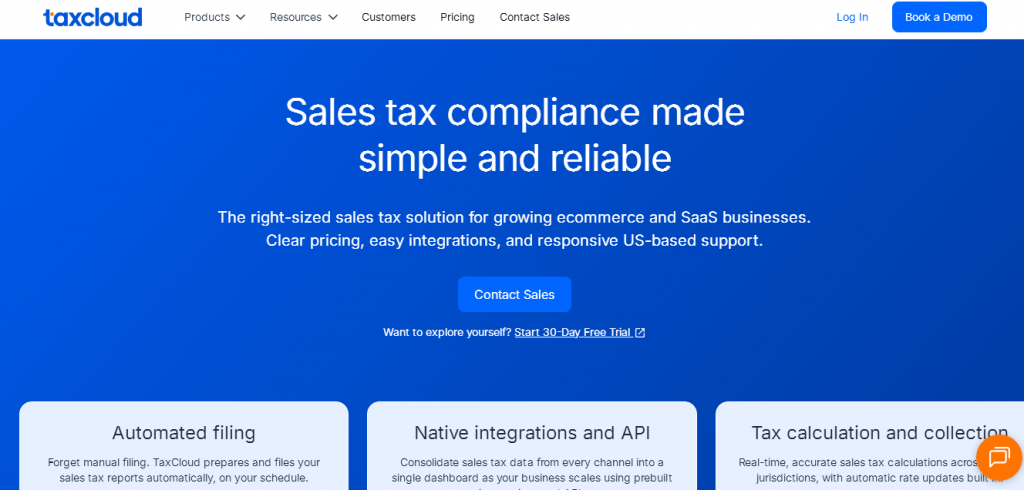
TaxCloud is a sales tax automation platform built for ecommerce and SaaS businesses that need real-time sales tax calculation, automated filing, and audit support without enterprise-level complexity. It helps small to mid-sized businesses stay compliant as they grow across more U.S. states and expand into Canada when nexus thresholds are reached.
Unlike accounting-first tools, TaxCloud operates mainly as a sales tax compliance engine. It connects to ecommerce platforms and calculates the correct sales tax at checkout based on product taxability and customer location. It also tracks nexus exposure and supports filing and remittance.
TaxCloud is often chosen by businesses that want automation for sales tax calculation and filing but do not require deep ERP-level configuration.
Key features
- Real-time sales tax calculation based on state and local jurisdiction rules
- Economic nexus tracking to monitor where registration and filing obligations arise
- Automated sales tax filing across the U.S. and Canada
- Product taxability categorization to ensure correct treatment of different goods
- Integration with ecommerce platforms like Shopify, WooCommerce, and BigCommerce, as well as custom carts via the TaxCloud API and manual data uploads via CSV files
- Sales tax reporting dashboard with visibility into collected taxes, filing status, and return-ready reports
Pricing
TaxCloud uses a tiered pricing model based on order transaction volume and services required.
| Pricing plan | Price | Features |
| Starter | $19/month (30-day free trial of all features available) | The Starter plan includes 100 orders per month and is best suited for Shopify and marketplace sellers who need sales tax reporting and filing. |
| Premium | $79/month (30-day free trial of all features available) | The Premium plan includes 200 orders per month and is best suited for growing ecommerce and SaaS businesses that need a full sales tax compliance solution. |
| Filing subscriptions | $39/per return, goes down to $25 (available for Starter and Premium) | TaxCloud’s filing subscription is an optional service. Users can file on their own or delegate filing to TaxCloud. It operates on a pay-as-you-go basis. |
| Additional services | Custom | State registration assistance, audit support, custom onboarding, dedicated customer success and filing managers, and expanded compliance services such as VDAs. |
When to choose TaxCloud
TaxCloud is built for growing ecommerce brands across the U.S. seeking a cost-effective solution with real, U.S.-based human support.
Full comparison of sales tax automation software
Below is a high-level comparison to help you see how these tools differ in focus, coverage, and typical usage. The table doesn’t declare one “best for everyone,” but shows where each solution tends to be stronger so you can match it to your real business challenges.
| Software | Best suited for | Core strength | Filing approach | Accounting integration strength |
| Synder | Businesses that care about accurate books and clean reconciliation as much as tax | Tax amounts tied directly to real transactions and accounting structure | Reliable accounting sync for reporting and filings | Very strong (QuickBooks Online, Xero, Sage Intacct, NetSuite, Puzzle) |
| Avalara | Companies where compliance, filings, and regulatory scale are top priority | Broad jurisdiction coverage and automated filing workflows | Direct automated filings | Strong across ERPs and ecommerce |
| TaxJar | Ecommerce sellers who want straightforward calculation and filing without heavy setup | Simple reporting, filing assistance, and marketplace-friendly workflow | Direct automated filings | Platform focused, accounting indirect |
| Sovos | Organizations that treat tax as a controlled compliance function with strict processes | Strong regulatory depth, documentation, and enterprise compliance tooling | Direct filings with structured compliance processes | ERP-oriented |
| Vertex | Teams that need very accurate geographic tax determination for varied locations | Precise rule accuracy tied to detailed location logic | Direct automated filings | ERP-oriented |
| TaxValet | Businesses that want someone to actively manage ongoing tax operations for them | Managed service approach with human oversight plus technology | Filings handled by the TaxValet team | Software plus human support |
| CereTax | Teams that want transparency into how tax is actually calculated and applied | Clear rule logic, visibility, and explanation of each tax decision | Available depending on configuration | Strong with system integrations |
| Kintsugi | Sellers who want one system to handle monitoring and filings together | Unified automation that combines calculation, monitoring, registration, and filing | Direct automated filings | ERP-oriented |
| LOVAT | Businesses that sell across borders and need VAT, GST, and sales tax handled in one place | International tax coverage with threshold tracking and filing tools | Direct filings in supported countries | Platform- and marketplace- driven |
| TaxCloud | Ecommerce and SaaS businesses that want automated U.S. sales tax compliance without enterprise complexity | Real-time sales tax calculation, nexus tracking, and SST program support for growing online sellers | Automated filings available with optional pay-per-return filing service | Platform and ecommerce focused, accounting secondary |
Final thoughts
Sales tax works best when it’s treated as part of the transaction flow, not as a separate accounting task. When tax data stays connected to sales activity and is reflected accurately in your books, compliance becomes a repeatable process instead of a recurring cleanup exercise.
If you want tax data to match what really happens in your books, Synder can help make that easier. Keeping sales, refunds, fees, and tax data aligned across your ecommerce platforms and accounting system, it becomes a single source of truth not just for taxes, but also for revenue, payouts, and financial reporting when compliance work comes around.
FAQ
How does sales tax automation software benefit ecommerce businesses?
Sales tax automation software keeps tax rates accurate, records tax consistently across sales channels, and reduces the risk of filing mistakes. Such tools help you save time, stay compliant, and avoid unnecessary stress during reporting periods.
What are the challenges of implementing sales tax automation?
The main challenge of implementing sales tax automation is setting it up correctly, which includes connecting platforms and aligning tax rules. Once configured, it generally becomes much easier to manage than manual processes.
Can sales tax automation software handle multi-state tax compliance?
Yes, most sales tax automation platforms are designed to manage multi-state rules, thresholds, and filings as your business expands. The exact level of automation depends on the tool you choose and how you configure it.