.png)
If you’re looking at HighRadius alternatives, chances are something in your current setup isn’t clicking anymore. Maybe the platform feels heavier than the problem you’re trying to solve, as HighRadius was built mainly for Fortune 500 companies with complex processes . Maybe implementation took longer than expected, or everyday workflows require more effort than they should. These moments usually show up when finance teams evolve, processes change, and tools that once made sense start to feel less practical.
And let’s be honest, choosing financial software rarely happens in a vacuum. You’re balancing accuracy, control, visibility, and the reality of how your data actually moves between systems. So the question isn’t whether HighRadius is a strong product. It clearly is for certain use cases. The real question is whether it still fits the way you operate today, and whether there are alternatives that match your needs with fewer tradeoffs. In this article, we look at why finance teams explore HighRadius alternatives and review several specific options worth considering.
TL;DR
- HighRadius alternatives make sense when accounting accuracy and reconciliation effort matter more than enterprise collections logic.
- The strongest options automate at the data level and hold up as transaction volume grows.
- Measuring time saved and manual work removed is more reliable than comparing feature lists.
- Synder stands out by reducing reconciliation effort and keeping accounting data clean at scale.
Why choose HighRadius alternatives
When you look closely at why HighRadius alternatives come up in internal discussions, the reasons are often very practical:
- The system enforces rigid workflows that don’t match how your accounting team actually works.
- Small changes require support tickets or external consultants.
- The focus is heavily on enterprise AR, while core accounting accuracy gets less attention.
- Payment data feels abstracted instead of clearly traceable to ledger entries.
- Implementation and maintenance effort outweigh the operational benefit.
At this point, the question usually shifts. Do you need a full AR orchestration platform, or do you need cleaner data flowing into your accounting system with fewer assumptions baked in? For many teams, especially in ecommerce accounting and SaaS, alternatives offer more control with less overhead.
Best HighRadius alternatives
Here are HighRadius alternatives that come up most often when teams want more control, clearer data, or less operational overhead.
1. Synder
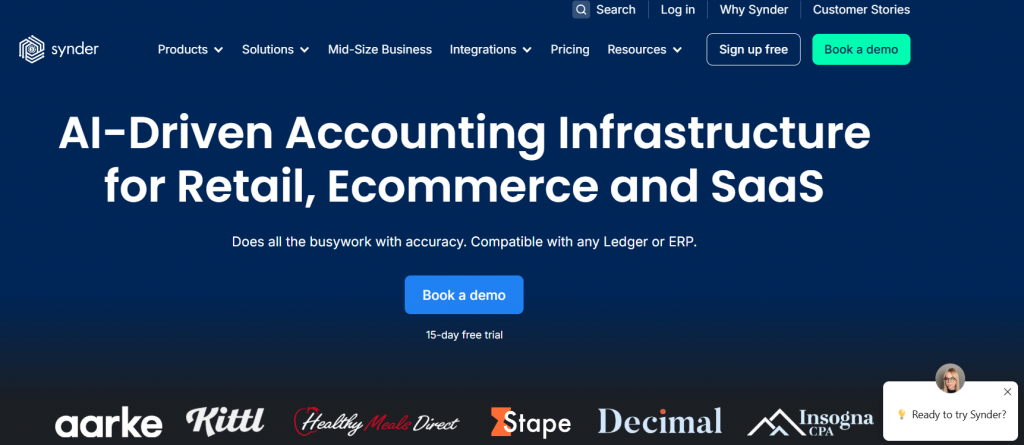
Synder is an accounting automation platform that approaches automation from a different angle than HighRadius. It’s built for teams that want payment and sales data to arrive in their accounting system already structured, rather than fixed after the fact. Instead of adding another control layer on top of accounting, it focuses on correctness at the point of entry. That makes it especially relevant when reports technically balance but feel unreliable, or when tracing a number back to its source takes more effort than it should. The result is accounting data that reflects real activity, not interpretations imposed later.
Key features
- Direct sync with QuickBooks Online, Xero, NetSuite, Sage Intacct, and Puzzle
- Automated sync of sales, fees, refunds, and chargebacks from payment platforms
- Flexible sync options: Per Transaction mode and Summary Sync mode
- Automatic clearing account handling for payment platforms
- Fee, tax, refund, and dispute visibility without manual adjustments
- Revenue recognition aligned with ASC 606 and IFRS 15
- Multi-channel support for ecommerce and SaaS platforms
- Balance reconciliation across platforms to ensure accurate books
Pricing
| Pricing plan | Price (billed annually) | Features |
| Basic | $52/month | Up to 500 transactions per month, two connected platforms, daily sync frequency, and core inventory and multi-currency support |
| Essential | From $92/month | 500 to 3,000 transactions per month, unlimited platform connections, hourly syncs, and expanded inventory management |
| Pro | From $220/month | Up to 50,000 transactions per month, advanced product mapping, bundle and assembly support, and guided onboarding |
| Premium | Custom pricing | Multi-entity structures, tailored onboarding, and priority level support |
Best for
Synder is a good choice for ecommerce businesses that deal with high-transaction volume from payment platforms or marketplaces and want receivables and cash data to land in accounting with minimal manual adjustment.
Considering alternatives to HighRadius? Start a free Synder account or book a demo to see how sales and payment data lands in your accounting system without added layers.
2. Billtrust

Billtrust is an accounts receivable platform focused on billing, payments, and collections for B2B companies. It’s often used by teams that manage invoicing at scale and need tighter control over how customers receive, pay, and dispute invoices. Compared to HighRadius, Billtrust is usually seen as more modular, with teams adopting specific components instead of a full enterprise suite from day one.
Key features
- Electronic invoicing and invoice delivery management
- Multiple payment options including cards, ACH, and virtual cards
- Automated cash application for invoice based payments
- Customer portals for invoice access and payment
- Collections tools with prioritization and communication tracking
Pricing
Pricing is modular and typically based on selected features, transaction volumes, and payment usage, with custom quotes for larger teams.
Best for
Billtrust is well-suited for B2B finance teams that manage high invoice volumes and want more control over billing, payments, and customer interactions
3. Upflow
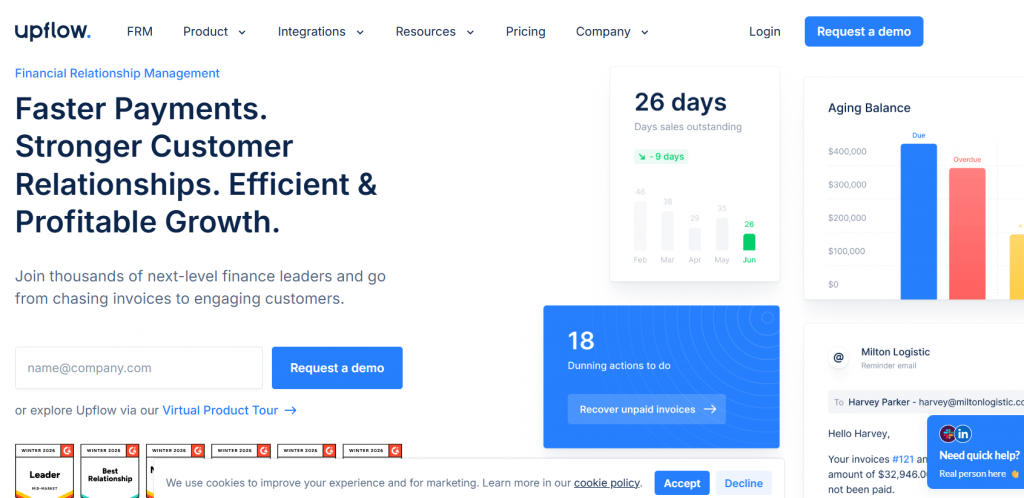
Upflow is positioned around visibility and collaboration rather than heavy automation logic. It’s often adopted by businesses that want a clearer view of who owes what, which invoices need attention, and where conversations with customers stand. Instead of replacing accounting systems, it sits alongside them and focuses on making AR status easier to understand and act on, especially in fast growing SaaS and service based businesses.
Key features
- Centralized AR dashboard with real time invoice status
- Shared workspace for finance and sales around customer accounts
- Automated payment reminders with customizable timing
- Customer notes and communication history tied to invoices
- Integrations with common accounting systems and CRMs (Xero, NetSuite, Sage Intacct)
Pricing
| Pricing plan | Pricing details |
| Discover | Free forever tier for teams exploring AR health |
| Grow | Tailored pricing for businesses with up to $10M ARR |
| Scale | Tailored pricing for companies $10M–$50M ARR |
| Strategic | Tailored pricing for $50M+ ARR |
| Starting benchmark | Approximately $440/month for basic subscription plans (independent listing) |
Best for
Upflow is particularly useful to teams that want better day to day control over receivables, need alignment between finance and sales, and prefer a lightweight layer that improves visibility.
4. Gaviti
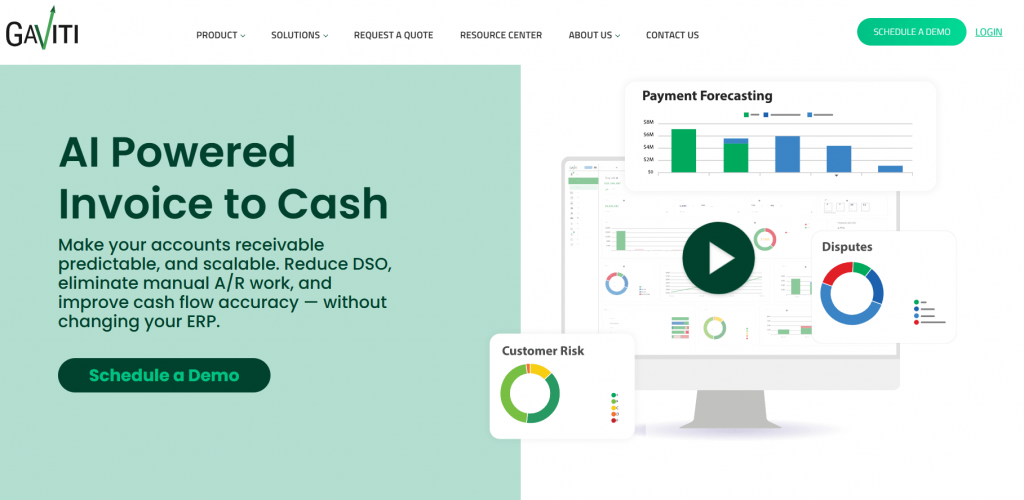
Gaviti is centered on collections execution not accounting mechanics. It’s usually adopted by teams that already trust their numbers but want a clearer way to prioritize follow ups and manage collector workload. The platform emphasizes structure around who should contact whom, when, and why, which can be useful once invoice volume grows and collections stop being manageable from email alone.
Key features
- Rule-based collections workflows tied to invoice status
- Collector task management and prioritization
- Customer-level communication history
- Aging analysis and collections performance reporting
- Integrations with major accounting systems
Pricing
Gaviti uses custom subscription pricing based on receivables volume, number of users, and selected modules, with access provided through sales demos.
Best for
Gaviti is a solid option for companies that already have stable accounting data and want more structure around collections execution without replacing their existing accounting setup.
5. Centime
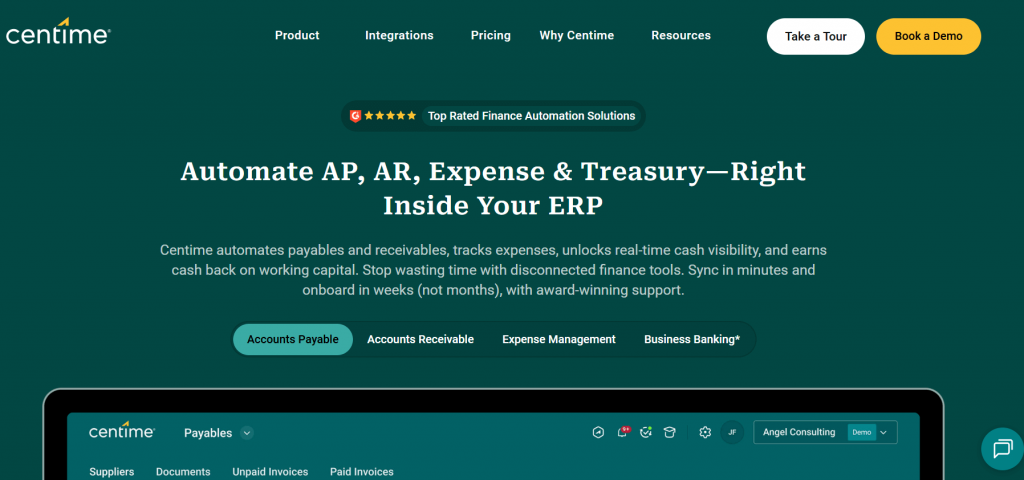
Centime is typically evaluated by businesses that want tighter control over cash visibility. It connects AR and AP data to show how receivables timing affects short term cash position, which can be helpful when payment delays start impacting planning decisions. Instead of driving collections behavior directly, it focuses on forecasting and scenario analysis built on existing accounting data.
Key features
- Real-time cash flow forecasting based on AR and AP
- Payment behavior analysis by customer
- Scenario modeling for delayed or early payments
- Integrations with major accounting systems (QuickBooks Online, NetSuite, Sage Intacct)
- Dashboards focused on liquidity and near term cash position
Pricing
Centime uses subscription based pricing that scales with company size and feature access, with plans available through sales discussions.
Best for
Centime fits companies that want better cash visibility and forecasting tied to receivables, especially when understanding timing matters more than managing collections workflows.
6. Tesorio
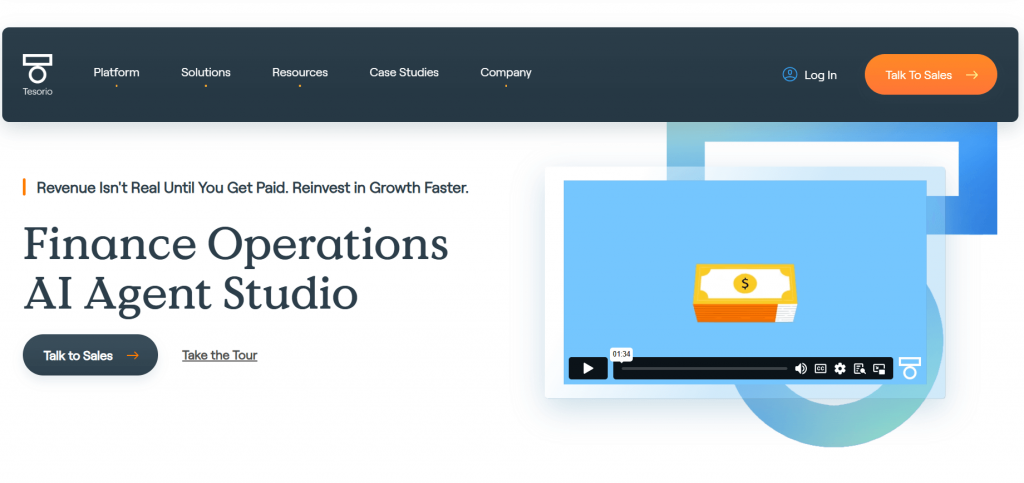
Tesorio is usually considered when companies want more consistency in how collections are executed across customers and regions. It focuses on standardizing follow ups, aligning internal teams around shared priorities, and reducing reliance on individual judgment calls. Tesorio doesn’t act as an accounting system extension but operates as a coordination layer that brings structure to receivables operations.
Key features
- Automated collections playbooks based on customer behavior
- Centralized communication history across email and notes
- Prioritization of accounts based on risk and impact
- AR reporting focused on overdue balances and trends
- Integrations with common accounting and CRM systems
Pricing
Tesorio offers custom subscription pricing based on company size, AR volume, and configuration, available through direct sales engagement.
Best for
Tesorio works well for teams that need repeatable collections processes across a growing customer base and want consistency.
Choosing the right HighRadius alternative
When AR automation is part of the decision, it helps to anchor the evaluation in outcomes that can actually be measured in finance operations.
- Map automation to time saved per cycle. In real setups, strong automation can reduce daily reconciliation work from 3 to 4 hours down to roughly 30 to 45 minutes, even when operating across more than 30 locations.
- Look at scale, not demos. Systems that handle large volumes of records automatically each month remove the need for repetitive posting and review that would otherwise consume entire workdays.
- Quantify manual work removed. Proper AR automation often eliminates over 40 hours of monthly data entry that would otherwise fall on accounting or bookkeeping teams.
- Translate time savings into cost impact. Removing that level of manual effort can mean more than $60,000 saved annually in external or internal bookkeeping costs.
- Validate how automation respects accounting logic. Speed only matters if revenue, fees, and cash still land correctly in the ledger.
The most reliable alternatives are usually the ones where automation shows up in close timelines, staffing needs, and error rates, not just in feature lists.
Conclusion
Evaluating HighRadius alternatives often reveals a shift in priorities. Once AR processes are stable, the real constraint becomes how quickly and reliably financial data turns into usable reports. Tools that add structure but slow down access to clean numbers tend to create friction over time.
Stronger alternatives focus on repeatability. They produce the same result every cycle, handle growing volumes without manual fixes, and keep the path from source data to the ledger easy to follow. That consistency matters more than advanced logic when decisions depend on timely, accurate reporting.
In practice, the better choice is the system that fades into the background. When automation works as intended, software like Synder helps accounting teams spend less time validating mechanics and more time trusting the numbers.
FAQ
What are the best HighRadius alternatives for mid-sized businesses?
The best alternatives depend on where complexity sits. Many mid-sized teams look for tools that reduce reconciliation time, handle growing data volumes, and keep accounting data easy to trace, rather than enterprise grade collections orchestration.
Is HighRadius too complex for some finance teams?
For teams without large, dedicated AR operations, HighRadius can introduce more structure than needed. In those cases, alternatives with lighter setup and clearer accounting outputs are often easier to maintain long term.
How do HighRadius alternatives compare on automation?
Most alternatives automate different layers. Some focus on collections workflows, others on cash visibility, and some on automating how sales and payment data enters the ledger. Comparing automation only makes sense when you align it with the work you want to remove.
Can Synder replace HighRadius for AR and accounting automation?
In many multi-channel ecommerce and SaaS setups, Synder is used instead of HighRadius when the priority is reducing manual reconciliation, handling high transaction volumes, and keeping accounting data consistent without enterprise level overhead.