
Shopify calculates and charges sales tax for you, but it does not register, file, or remit on your behalf. The store owner is the legal collector of record in every state where the business has nexus, and the platform’s role stops at the checkout calculation. That gap, between what sellers assume Shopify does and what it actually does, is where most compliance trouble starts, and it gets expensive once a state notices.
This article covers what Shopify actually handles at checkout, where you may owe sales tax, and how Shopify Tax compares to other options. It also explains how to set up your bookkeeping so collected tax stays separate from revenue and your numbers line up correctly when it is time to file.
TL;DR
- Sales tax in the U.S. is complex and constantly changing: There’s no single system, and with over 12,000 jurisdictions and frequent rate updates, so manual tracking doesn’t scale.
- You only collect tax where you have nexus: That can come from physical presence or hitting economic thresholds, and most growing Shopify stores end up triggering both.
- Shopify calculates tax, but you’re still responsible for compliance: It applies the correct rates at checkout, but registration, filing, and remittance remain on you.
- Marketplace rules add another layer: Platforms like Amazon collect and remit for you, but your Shopify store usually doesn’t, except for Shop app orders.
- Bookkeeping is where things break if setup is wrong: Sales tax must be recorded as a liability, not revenue, and clean tracking often requires automation or a CPA as volume grows.
What is sales tax, and why can’t Shopify make it simple?
Sales tax in the U.S. is less of a single rule and more of a patchwork you step into the moment you start selling. Every time a customer checks out, a small slice gets added to the price – not for you to keep, but for you to pass along to a state or local tax authority.
There’s no nationwide rate tying it all together. Instead, 45 states and Washington, D.C. run their own systems, and then counties, cities, and special districts layer on top of that. That’s how you end up dealing with more than 12,000 different tax jurisdictions, depending on where your customer happens to be.
But the more important number is how jurisdictions change. According to Vertex’s 2025 End-of-Year U.S. Sales Tax Rates and Rules Report, 12,414 jurisdictions saw rate or rule changes during the year, with 335 brand-new city, county, and district taxing jurisdictions created, a ten-year high. Six hundred and eighty-one total rate changes were enacted, and at the city level, increases outnumbered decreases nearly five to one.
Vertex’s senior tax officer framed how unusual that level of churn is in the company’s February 2026 announcement:
The pace and scale of sales and use tax changes in 2025 are unlike anything we’ve seen in recent years.
Chris Hall, Senior Tax Officer at Vertex
| For a Shopify seller, that’s the underlying problem the platform is trying to solve at checkout. The calculation has to land on the correct rate for the right product category in the right rooftop, on a day when one of those three variables may have changed last week. And spreadsheets can’t keep up with that pace. That’s the context for what Shopify does, and what it leaves to the seller. |
Where you owe sales tax: physical and economic nexus
Nexus is the moment a state starts to recognize your business as part of its tax system, even if you’ve never set foot there. Up until that point, you don’t collect sales tax, but once you cross that line, every new sale into that state comes with an obligation attached. For ecommerce sellers, that line is usually crossed in two ways: through a physical presence or through sales volume, and as Shopify stores grow, it’s common to trigger both.
Physical nexus
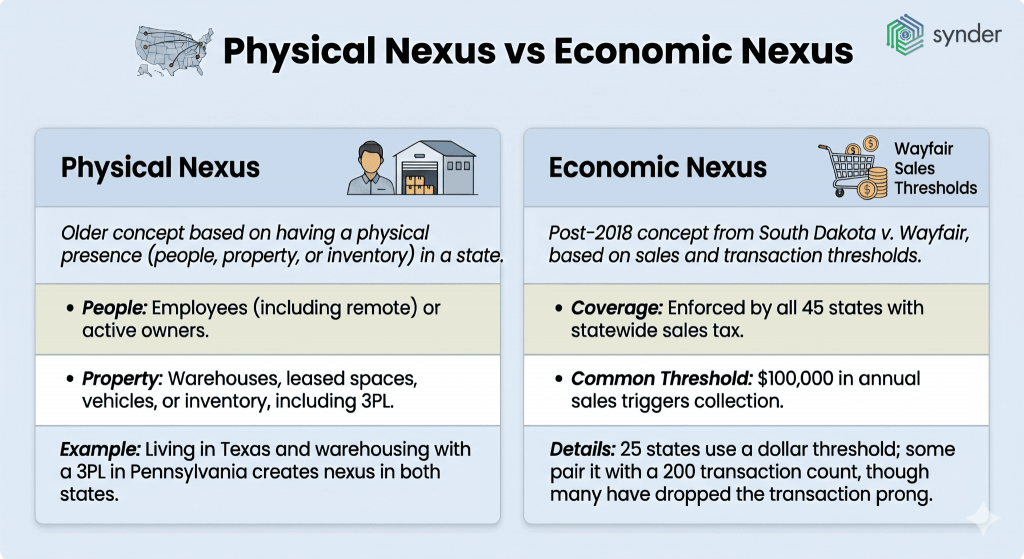
Physical nexus is the older concept, and the easier one to check. If your business has people, property, or inventory in a state, that state can require you to register and collect. People means employees, including remote workers, and owners actively running the company. Property includes warehouses, leased space, vehicles, and any inventory stored in a fulfillment center, including third-party logistics providers. A Shopify seller who lives in Texas, for example, and warehouses inventory with a 3PL in Pennsylvania, has physical nexus in both states from day one.
Economic nexus
Economic nexus is the post-2018 layer that came out of the Supreme Court’s South Dakota v. Wayfair decision. According to the Tax Foundation’s 2024 economic nexus tracker, all 45 states with a statewide sales tax now enforce an economic nexus threshold, and 25 states use a dollar threshold, most commonly $100,000 in annual sales, to trigger collection by an out-of-state seller. Some states still pair the dollar test with a transaction count, often 200 invoices, though several have dropped the transaction prong as it caught too many small sellers.
The threshold resets each calendar year, and most states only count sales going forward once you cross it. The 200-transaction prong matters most for sellers with low-ticket, high-volume products, since 200 invoices at $20 each gets you to nexus before the dollar threshold ever fires. Once you cross, you have a window to register, configure the new state in Shopify, and start collecting.
Related read: How to File Taxes for Your Ecommerce Business: The Complete Guide
Does Shopify collect sales tax automatically?
Shopify does not automatically collect sales tax for you in a legal sense, but it does automatically calculate and add it at checkout once you’ve set it up.
Once your store is configured, Shopify handles the calculation at checkout, applying the right rate based on the customer’s location and the product category, which takes a lot of complexity off your plate. It’s best to think of Shopify as the calculator (not the taxpayer), because you’re still the one responsible for registering in the states where you have nexus, enabling tax collection, and making sure your products are mapped correctly.
The setup is in your admin under Settings → Taxes and duties, where you turn on collection for each state, confirm product tax categories, and let Shopify apply those rules at checkout.
For U.S. sellers, Shopify Tax is usually the default choice since it calculates rates down to the exact delivery address and keeps them updated automatically, although there are simpler or manual options if you need a different level of control.
Does Shopify report or remit sales tax?
Shopify gives you the reports, but it doesn’t file them for you. The platform breaks down what you collected by state and jurisdiction, so you have the numbers ready, though turning those numbers into an actual return and getting them to the state is still your job. There’s an automated filing add-on available on certain plans, but it’s not the default and not every seller has access to it.
So registration, filing schedules, and the actual remittance all fall to you. Each nexus state (will speak about it later) needs its own permit, and each one expects returns on its own cadence, monthly, quarterly, or annually, depending on your volume. A Shopify report tells you what you collected, but it doesn’t tell the state.
Check out our article on how to categorize Shopify transactions and fees in QuickBooks Online.
How sales tax is calculated on Shopify
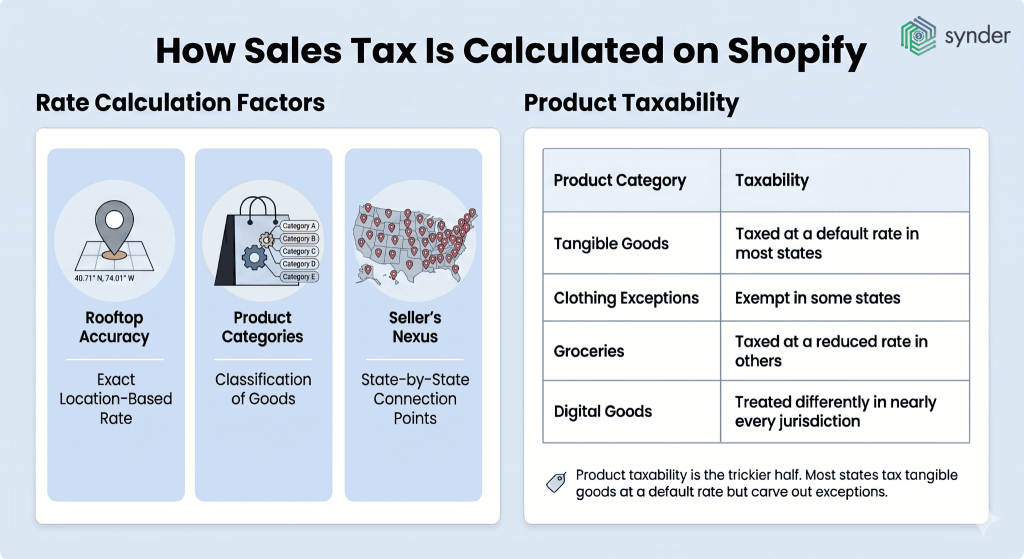
Shopify Tax calculates the rate using:
- The customer’s exact delivery address
- The product category assigned to each item
- The seller’s nexus configuration
The platform does the destination-based math at checkout and shows the buyer a single tax line, which is then split out in the order’s tax breakdown for reporting purposes. Sellers using the standard Shopify Tax setup get rooftop-level accuracy, meaning two houses on the same street can be charged different local rates if their tax jurisdictions differ.
Product taxability
Product taxability is the trickier half. Most states tax tangible goods at a default rate but carve out exceptions, with clothing exempt in some states, groceries taxed at a reduced rate in others, and digital goods treated differently in nearly every jurisdiction.
Take New Jersey as an example, where most everyday clothing and footwear are exempt from the 6.625% sales tax. But the moment you move into things like fur clothing, accessories, sports or recreational gear, or most protective equipment, that exemption no longer applies. It means a Shopify seller running an apparel store has to know that a t-shirt ships tax-free to a New Jersey customer, but a leather handbag, a baseball glove, or a pair of safety goggles do not, and Shopify Tax will only get that right if each product has been mapped to the correct subcategory.
| Note: Shopify pulls from a large taxonomy of product categories and applies the right rule when you assign a category, but if a product is mis-categorized, the platform will apply the wrong rate every time. |
Shopify nexus tracker
Shopify also offers a nexus tracker that monitors your sales by state and warns you when you’re approaching a threshold, typically at the 80 percent mark. That feature alone has earned the platform a lot of goodwill, because it answers the question store owners can’t easily answer themselves: “Am I about to owe tax in another state?“ The tracker doesn’t register you with the new state when you cross the line, but it tells you the line is coming.
Why Shopify isn’t a marketplace facilitator and why that matters
Marketplace facilitator laws shifted the collection burden from individual sellers to the platforms hosting them, but only for true marketplaces. According to the Streamlined Sales Tax Governing Board, every U.S. state that imposes a sales tax now has a marketplace facilitator law on the books. Under these laws, platforms like Amazon, Etsy, eBay, and Walmart are legally classified as marketplace facilitators and are required to collect and remit sales tax on behalf of the third-party sellers using them.
But a standard Shopify storefront isn’t classified as a marketplace facilitator in most states. The seller controls the store, they’re the merchant of record, and the legal entity to collect and remit taxes.
The Shop app exception
There is one place where Shopify does act as a marketplace facilitator, and it accounts for most of the Marketplace Facilitator Tax line items sellers see in their payouts. Since January 1, 2025, orders placed inside the Shop app or on the consumer-facing shop.app website, have been classified as a marketplace facilitator. Shopify automatically collects, remits, and files sales tax on those orders in every state with a statewide sales tax, and reports it under SC Commerce Services Inc., not under the seller’s own permit.
| Important caveat: this only applies to orders placed inside the Shop app itself. Orders that come through the seller’s own Shopify storefront and happen to use Shop Pay at checkout are not Shop channel orders, and the seller still owes the tax on those. |
For the seller, the practical takeaway is that any Marketplace Facilitator Tax line item should never be added to the seller’s own Sales Tax Payable liability, because the seller never collected that money and doesn’t owe it. We’ll come back to how to book that line item correctly in the bookkeeping section.
Discover how to record Shopify sales in QuickBooks.
What Shopify covers vs. what the seller still owns
| Compliance task | Shopify | Seller |
| Calculating sales tax at checkout | Yes, with rooftop accuracy | Configure product categories correctly |
| Tracking economic nexus thresholds | Yes, alerts at 80% / 100% | Register once threshold is crossed |
| Updating rates as jurisdictions change | Yes, automatic | Verify accuracy in audit |
| Registering with state revenue agencies | No | Required in every nexus state |
| Filing sales tax returns | Add-on in some plans only | Required, monthly/quarterly/annual |
| Remitting collected tax to the state | Add-on in some plans only | Required |
| Reporting tax on a return when products are exempt | No | Confirm taxability per state |
| Reconciling Shopify tax to other channels | No | Required for multi-channel sellers |
| Recording marketplace facilitator tax in books | No | Required, varies by platform |
Bookkeeping for Shopify sales tax
Bookkeeping is often the point at which sales tax issues become visible, even if everything looked fine earlier. You might have the calculation right and file on time, but if the collected tax ends up recorded in the wrong place, the numbers won’t line up when you reconcile the return with your books. And as your Shopify sales grow, this tends to get harder, which is why many sellers eventually bring in an experienced ecommerce CPA or put an automation layer like Synder in place between the storefront and the accounting system.
Why sales tax is a liability, not revenue
Sales tax collected from a customer is not revenue. It’s a liability owed to a tax authority, and it appears on the balance sheet in a Sales Tax Payable account until the return is filed. Treating it as revenue creates several distinct problems at the same time:
- Inflated top line. Gross sales numbers look bigger than they actually are, which throws off every margin and growth calculation built on them.
- Distorted gross margin. Cost of goods sold is being measured against a revenue figure that includes money you don’t keep, which makes margins look stronger than they are.
- Broken reconciliation at filing time. When the return goes to the state, the books say one thing, and the platform reports say another, and someone has to reconcile the gap manually.
The fix starts before sales tax is even part of the picture, with the basic financial hygiene that lets the books be trustworthy in the first place. CPA Chris Rivera made this point in a piece on ecommerce tax accounting published by LinealCPA:
Even if you’re just starting out, you need dedicated business bank accounts and credit cards. This separation isn’t optional — it’s essential for accurate reporting and audit protection.
Chris Rivera, a CPA
This advice extends to how collected sales tax is handled in the books. Treating it as cash in the operating account, and not as a state liability earmarked for remittance, is one of the most common mistakes growing Shopify sellers make.
How to structure your books for clean tax tracking
The cleanest setup separates three flows in the accounting system, and each one has a different home in the chart of accounts. When the books are structured this way, the Sales Tax Payable balance at any point in time is what the seller actually owes to the state, and the monthly return becomes a matter of reconciling that balance against what gets filed and paid.
- Gross sales are recorded in a sales income account, the way ordinary revenue would.
- The sales tax portion of each order is posted to a sales tax payable liability account, broken out by state if filing complexity warrants it.
- Marketplace facilitator tax, the amount already remitted by Shopify on Shop channel orders or by another platform, is recorded as a non-taxable line item on the sale and offset in expenses, so it never inflates the seller’s own payable balance.
Doing this manually across thousands of monthly orders is where most Shopify sellers run out of patience, which is what makes the automation question worth asking before the books drift.
How automation helps
Synder is an accounting automation tool that helps businesses sync ecommerce and financial data across 30+ platforms, including Shopify, into accounting systems like QuickBooks Online, Xero, Sage Intacct, Oracle NetSuite, Puzzle, and Intuit Enterprise Suite. It supports two sync modes: Per Transaction, which posts each sale individually with the full tax breakdown, and Summary Sync, which posts daily or payout-based summaries.
For sales tax tracking specifically, both modes apply tax codes (in non-US QuickBooks) or post directly to Sales Tax Payable liability accounts (in US QuickBooks, where journal entries don’t support tax codes). When a Marketplace Facilitator Tax line item appears, whether from a Shop channel order or from a parallel marketplace like Amazon, eBay, or Etsy, both modes record it as a separate non-taxable line, so it never inflates the seller’s own Sales Tax Payable balance.
Learn how to integrate Shopify and QuickBooks.
A real example of this is a Long Island-based meal prep business running Shopify and PayPal into QuickBooks Online. It was losing three to four hours every day to manual reconciliation across 30+ store locations, and their sales tax wasn’t clearly separated in the books, which made it nearly impossible to comply with New York State’s Prompt Tax submissions.
After automating transaction sync and tax categorization at the line-item level, the team cut that daily work to 30 to 45 minutes and saved more than 70 hours a month, with sales tax now broken out by location and county directly in QuickBooks.
If you want to see how transaction-level tax tracking and marketplace facilitator handling work in practice, you can book a demo with Synder.
Conclusion: what this Shopify sales tax guide leaves with you
If you strip it down, the answer to “does Shopify collect sales tax” is yes on the calculation side, and no on the legal side. Shopify Tax handles checkout really well, applies the right rate to the right delivery address, keeps up with changing jurisdictions, and even helps you keep an eye on nexus thresholds. But it stops short of taking responsibility for what happens next, since registering, filing, and remitting still sit with you as the store owner, and that workload grows quickly as you expand into more states, channels, and product categories.
Everything that falls outside checkout, like registering in new states once you cross a threshold, handling marketplace facilitator tax that has already been remitted, keeping collected tax separate from revenue in your books, and making sure your returns actually match what Shopify reported, tends to be where things get complicated.
That’s also the point where most sellers bring in an experienced ecommerce CPA or set up an automation layer between Shopify and their accounting system, and it’s usually worth doing earlier.
FAQ
What happens if a Shopify store collects sales tax in a state where it isn’t registered?
Collecting sales tax without a permit is generally treated as more serious than under-collecting. Most states require that any tax collected be remitted, and collecting before registration can trigger penalties on top of the unremitted amount. The fix is to register retroactively where possible, remit what was collected, and reconfigure Shopify so collection only happens in registered states.
Does Shopify Payments handle sales tax differently than other gateways?
No, the payment processor doesn’t change the tax obligation. Shopify Payments handles the card processing, while Shopify Tax handles the calculation, and the seller still owns the registration, filing, and remittance. The one thing that does change with Shopify Payments is 1099-K reporting at year-end, which goes to sellers who exceed the federal gross payments threshold.
How are digital products taxed on Shopify?
Digital product taxability varies sharply by state, with some states fully taxing digital downloads, others exempting them, and a few applying special rates. Shopify Tax assigns digital goods to a separate category and applies the relevant state-by-state rule, but sellers should verify the categorization is correct, especially for software-as-a-service or hybrid digital-plus-physical bundles.
Should a small Shopify seller use Shopify Tax automated filing or a third-party service?
It depends on volume and complexity. Shopify Tax automated filing works well for sellers with one channel and a handful of nexus states, where the calculation and the filing live in the same system. Sellers with multiple sales channels, higher transaction volumes, or complex product taxability typically benefit more from a dedicated tax compliance service paired with an accounting automation solution like Synder that consolidates data across channels before the return gets filed.