

- How to validate your results
- Prerequisites
- Reconciling deferred revenue
- Detailed comparison view
- Validation and maintenance
- Outdated status
- Reconciliation statuses
- Limitations & known constraints
This guide shows how to use the Deferred Revenue Reconciliation Report in Per Transaction mode. With this report, you can compare your QuickBooks Online Deferred Revenue account with Synder Revenue Recognition (RevRec). As a result, you can identify the specific transactions causing differences.
Use this report if you:
- Use Synder RevRec with QuickBooks Online
- Sync data in the Per Transaction mode
- You need transaction-level details for discrepancies
- Support the month-end close with confidence
This report will not work for you if you:
- Run RevRec without an accounting platform
- Expect current-month totals to fully match
- Use multiple unrelated Deferred Revenue accounts without having a single parent account
- If you’re using Summary mode. Please visit this guide for the Summary reconciliation option for Revenue Recognition.
How to validate your results
Once you’ve reviewed the Deferred Revenue Reconciliation Report, you should be able to clearly determine whether your revenue recognition data is aligned between Synder RevRec and QuickBooks Online.
After using this report, you can:
- Confirm that Deferred Revenue in QuickBooks matches RevRec
- See exact transactions causing differences
- Complete month-end reconciliation with confidence
Prerequisites
Before running the Deferred Revenue Reconciliation Report, make sure your setup reflects how the report is designed to work. These requirements ensure the comparison between Synder RevRec and QuickBooks Deferred Revenue is accurate and meaningful.
- Synder RevRec enabled
- QuickBooks Online connected as your accounting platform
- Deferred revenue recorded in liability accounts (other current liability or long-term liability)
Reconciling deferred revenue
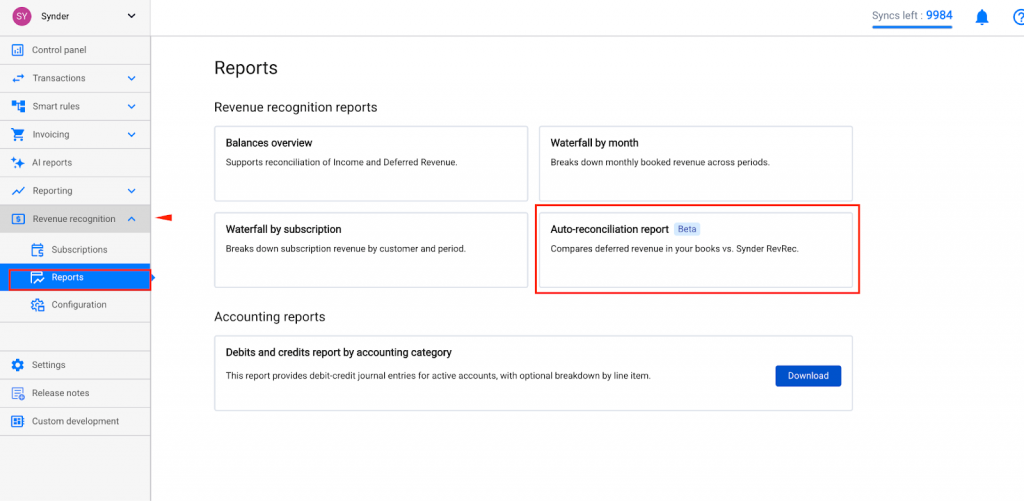
Step 1: Open the report
Go to Reports → Deferred Revenue Reconciliation.
Step 2: Select your Deferred Revenue account
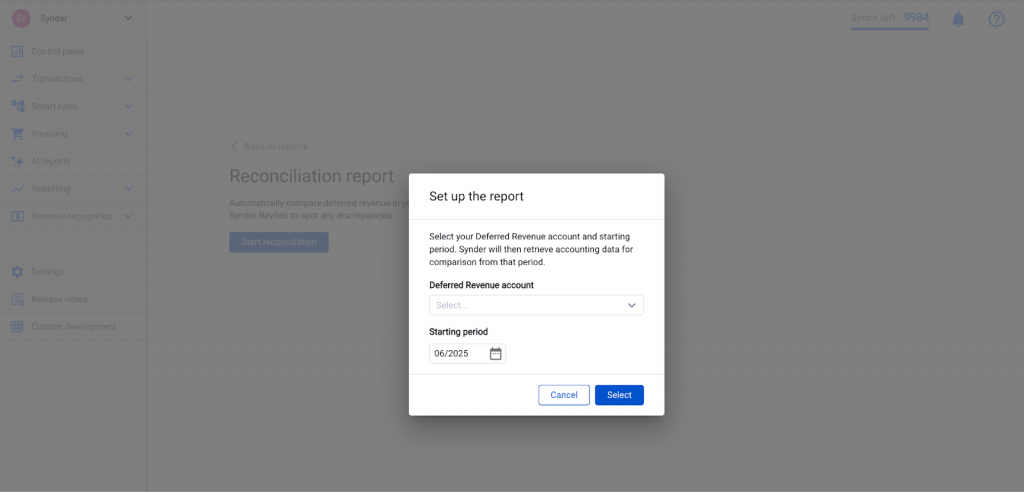
The first time you open the report:
- Choose your Deferred Revenue account from QuickBooks.
- Select the starting reconciliation period.
Important:
- If you use multiple Deferred Revenue accounts, they must be subaccounts of one parent.
- Select the parent account.
- Your selection is saved automatically.
Step 3: Choose the month(s) you want to reconcile
Only select completed months for reconciliation. The current month may appear in the report, but do not use it to validate balances. This is because Synder generates and syncs revenue recognition journal entries to QuickBooks Online only after the month closes. As a result, current-month totals will not match RevRec until then.
Step 4: Review differences
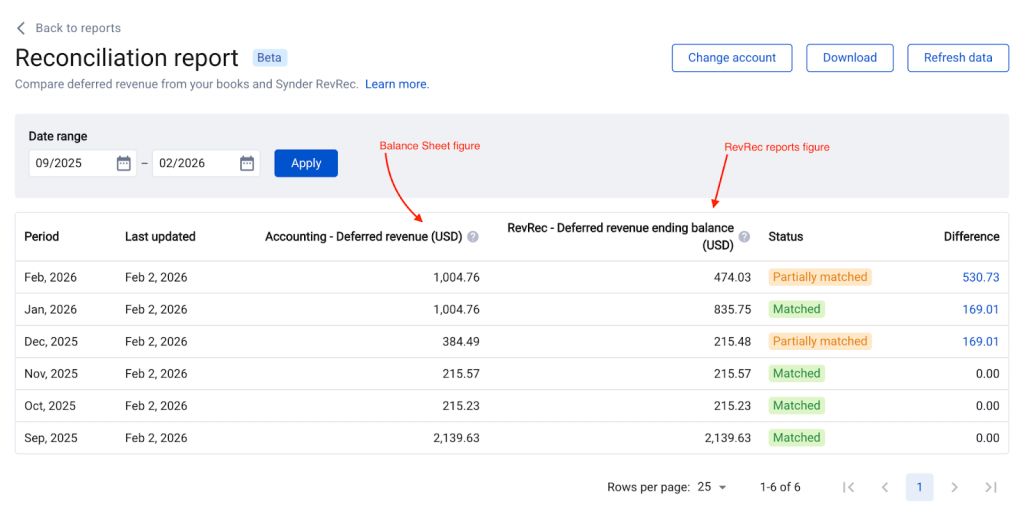
For every month, you’ll see three columns for your deferred revenue reconciliation:
| Column | Description |
| Accounting – <selected account name> | Selected account balance from your QuickBooks balance sheet by month |
| RevRec – deferred revenue ending balance | Synder RevRec ending balance of deferred revenue by month |
| Difference | The delta between the two balances |
Clicking the difference takes you to the detailed comparison view of your revenue. We’ll discuss this page in detail in the next chapter.
Detailed comparison view
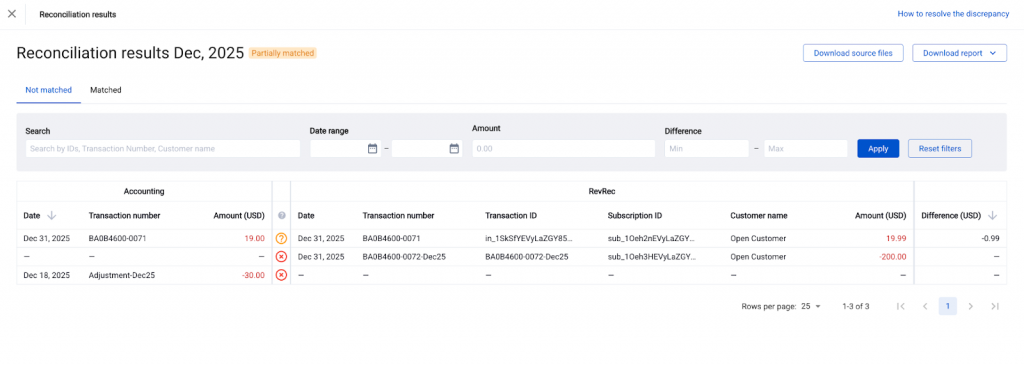
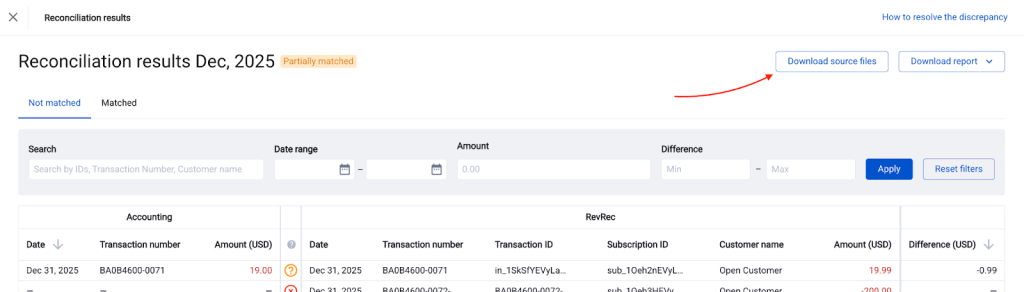
If you notice a difference between QuickBooks Online and Synder, click on the difference amount. This opens a line-by-line comparison.
You’ll see two tabs:
- Matched
This tab lists all lines that are perfectly aligned. Each line shares the same ID and the same amount.
Note: if multiple lines share the same ID, Synder collapses them into a single line and sums up the amounts.
- Not matched (default view)
This tab shows:
- Lines with the same ID but mismatched amounts
- Lines missing from either Synder or the accounting software
- Lines requiring review (e.g., amount differences, missing IDs)
This view helps you pinpoint exactly which transactions do not align. You can copy the IDs or Numbers to find the records in QuickBooks Online and RevRec. From there, investigate the differences.
Validation and maintenance
Keep the report up to date so it always reflects the most accurate data. Here is how to maintain it over time.
Refreshing the report
Synder refreshes the report automatically on the 5th of each month. However, you can also trigger a manual refresh:
- From a specific date, or
- From the RevRec start date
Large refreshes may take extra time. Synder sends you an email once the refresh is complete.
Outdated status
Synder checks the balance sheet and revenue recognition numbers every 24 hours.
If either the balance sheet data or RevRec data changes, the report shows an Outdated status. In that case, manually refresh the report starting from the first outdated period. This updates the numbers and restores accurate matching.
Downloading source files
At any time, you can export the raw reports used in the reconciliation. Synder sends them directly to your email address. The available files include:
- RevRec Incoming Revenue (Itemized)
- RevRec Recognized Revenue by Entry
- QuickBooks export from the selected Deferred Revenue account
Reconciliation statuses
Each month, the report will display one of the following:
| Status | Meaning |
| Matched | The app matched all transactions by transaction number and totals. |
| Partially matched | The app matched some transactions, but some are not matched. |
| Not matched | No matching transactions were found at all. |
| Retrieving data | Synder is fetching Balance Sheet numbers and reports for comparison from RevRec and from accounting. |
| Comparing data | Synder is comparing the reports received from accounting and from RevRec module. |
| Failed | Synder couldn’t retrieve or process the data. |
| Outdated | Figures in the Balance Sheet or in RevRec reports changed – refresh is required. |
Limitations & known constraints
Several setup constraints can affect how the report behaves. Review the scenarios below to understand when results may not align. Each section also explains how to fix the issue.
If QuickBooks Doc Numbers are enabled
When QuickBooks Online document numbers are enabled, transaction-level matching may fail. This happens because QuickBooks Online replaces Synder transaction numbers. As a result, ID-based matching becomes impossible.
How to fix:
Disable Doc Numbers in QuickBooks so Synder IDs remain intact.
What still works:
ou can still compare monthly totals, but not line-by-line matching.
If invoices were uploaded to RevRec via Excel and not synced
In this case, totals will not match. RevRec includes these invoices, but they do not exist in the Deferred Revenue account in QuickBooks Online.
How to fix:
Ensure those invoices hit the Deferred Revenue account with matching IDs.
If you use multiple Deferred Revenue accounts
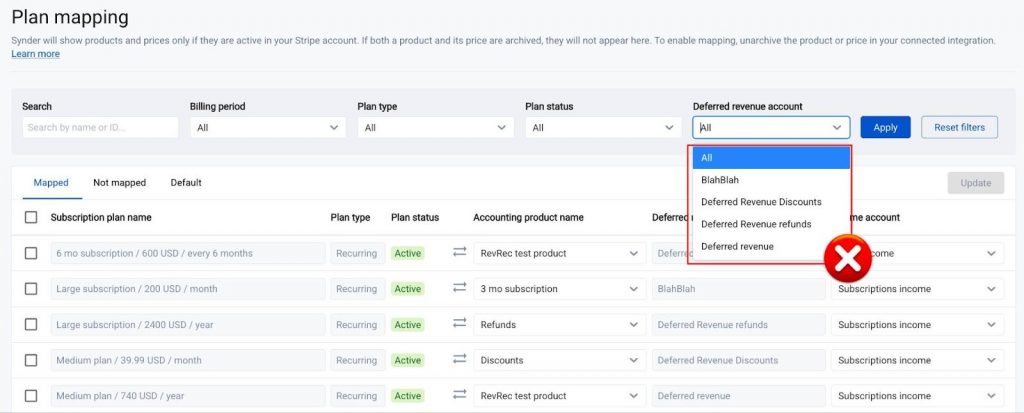
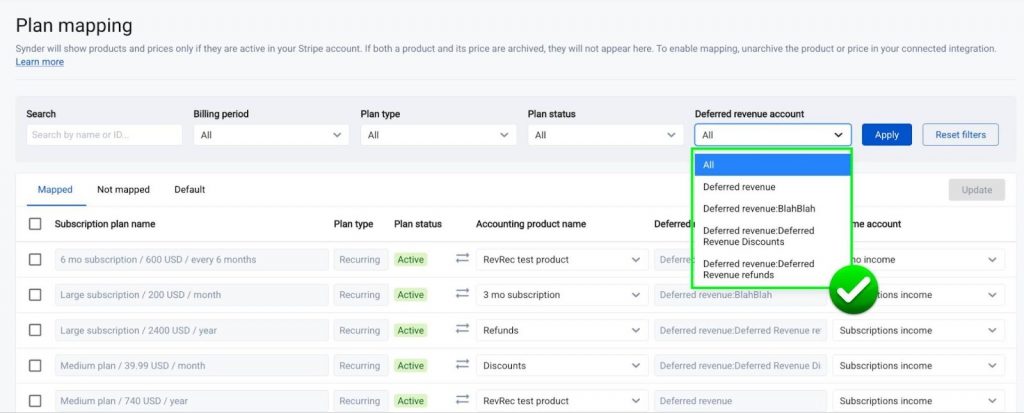
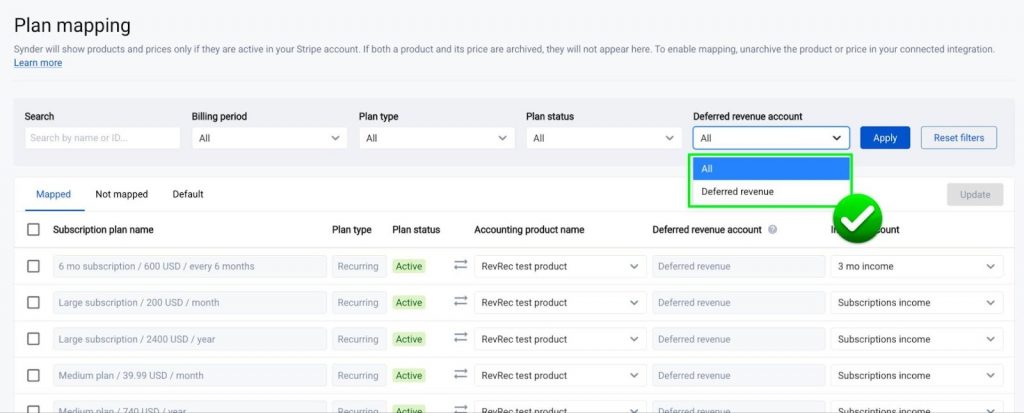
The report supports only a single Deferred Revenue account. If you use multiple accounts, the report will not reconcile correctly. How to fix:
Create a parent Deferred Revenue account and make all others sub-accounts. Go to the Chart of Accounts -> click Edit for the needed account -> check the box Make this a subaccount and select which account should be a parent account.
If you have any questions about your reconciliation results or need help interpreting any differences, reach out to Synder Support – we’re always here to help.
